
During my 15 year volleyball career I must have owned and dragged at least 10-15 different volleyball bags around various stadiums, courts, and gyms.
Believe me when I say I know exactly what makes for a good volleyball bag.
To the untrained eye, these bags and backpacks may just look like any old sports bag…
But there’s a ridiculously large range of volleyball bags on the market, some of which are excellent, and others that fall apart before the season’s even out.
And here’s the bit almost nobody mentions: the one feature that separates a proper volleyball backpack from a repurposed school bag is a ventilated shoe compartment.
Once you’ve owned a bag with one, you’ll never willingly go back to cramming damp court shoes in next to a clean shirt. Trust me on this one!
So today I’m running through what I think are the 10 best volleyball backpacks and bags actually worth your money in 2026. Seven of them have a proper shoe compartment, and I’ve thrown in a beach bag, a duffle, and a ball bag for the coaches and volleyball parents out there too.
At the end of the article I’ll explain exactly what things you need to look out for when shopping for a new volleyball bag or backpack.
Let’s begin!
10 Best Volleyball Bags & Backpacks At A Glance
Here’s the quick version, for anyone who doesn’t want to read four thousand words about zippers.
Best Overall
.
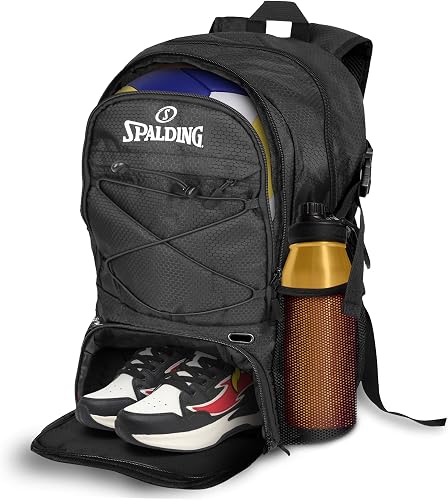
Spalding Volleyball Backpack Sports Bag
The only bag here that publishes its own size. 30 liters, 1.49 lbs, vented pockets for both ball and shoes.
Best Value
.

Hsmihair Backpack with Ball Holder and Cleat Compartment
Twenty dollars buys a vented ball pocket, a ventilated shoe compartment and a fence hook. Over 1,400 ratings.
Best Capacity
.

YOREPEK Large Basketball Backpack
Forty liters, four bottle holders, and a shoe pocket rated to size 10. Built for tournament weekends.
Best Shoe Compartment
.

MATEIN ll Bag with Ball Holder, Shoe Compartment
Shoe compartment stated to fit US size 12, and 9.5 inches deep, so a full-size volleyball actually goes in.
Best Wet Weather
.

Goloni Backpack with Ball and Shoe Compartment
Waterproof Oxford shell and a shoe lining you can pull out and wash. Same footprint as the Spalding, five dollars less.
Best for Beach
.

Wilson AVP Beach Volleyball Backpack
A base vent that dumps the sand out without unpacking, speed clips for wet knee pads, and a front ball panel.
Best External Ball Holder
.

DSLEAF Backpack with Ball Holder and Shoe Space
The ball straps to the outside, so it costs you no room inside. Wipe-clean base and a separate wet pocket.
Best for Girls & Youth
.

MATEIN Girls Sports Backpack with Fence Hook
One pound empty, reflective strips nobody else bothered with, plus a fence hook and a real shoe compartment.
Best Duffle Bag
.

Under Armour Undeniable 5.0 Duffle
Fifty eight liters and 26,000 ratings. No ball pocket, but the toughest base here and a vented laundry pocket.
Best Ball Bag
.

Mizuno Mesh Volleyball Bag
Fifteen dollars for a mesh sack that holds one ball and clips onto whatever bag you already own.
That’s not me being lazy. 6 of these ten manufacturers simply don’t tell you how big their bag is, and the volleyball retailers selling them don’t either. It’s the single most useful number when you’re buying a bag you can’t pick up and hold, and almost nobody publishes it.
More on that in the buying guide. Right. Let’s get into the reviews.
How I Picked These Volleyball Bags
Fifteen years of volleyball, and ten years of basketball before that, means I’ve bought a lot of sports bags. And thrown out even more.
So I know what kills a bag. It’s the zipper, the base, and a “shoe compartment” that turns out to be a pocket with delusions of grandeur.
For this list I went through every volleyball bag and backpack currently sold on Amazon and put each one through the same four questions:
Can it actually carry a volleyball?
You would be amazed how many bags marketed to volleyballers simply can’t. One of the most popular “volleyball” backpacks on the market is 7 inches deep. A volleyball is 8.25 inches across. You do the math…
Is the shoe compartment ventilated, or is it just a pocket?
There’s a big difference between a zipped hole in the bottom of your bag and a proper vented compartment that lets damp shoes breathe.
What’s the real capacity?
Whether you call it a volleyball gear bag, a volleyball equipment bag or just a backpack, almost no retailer publishes a liter figure. When I checked one popular bag across three different stores, I got 36L, “roughly 30L”, and no number at all. For the same bag!
10 Best Volleyball Backpacks And Bags For 2026: Detailed Reviews
Below is the full review of every volleyball backpack and bag that made the list. For each one I’ve covered what it actually holds, whether the shoe compartment is properly ventilated or just a pocket with a fancy name, the capacity in liters where the manufacturer bothers to publish one, and who the bag genuinely suits.
Prices were checked in August 2026 and they move around a fair bit, so treat them as a guide rather than gospel.
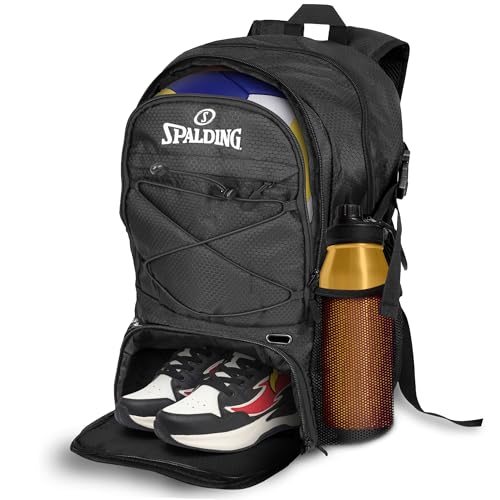 Spalding Volleyball Backpack Sports Bag
 The only volleyball backpack I found that actually tells you how big it is. 30 liters, 1.49 lbs, with vented compartments for both your ball and your shoes.
Best Overall: Spalding Volleyball Backpack Sports Bag
Let me start with the thing that put this bag at the top, because it’s going to sound underwhelming.
Sounds like a low bar, doesn’t it? It isn’t. Six of the ten bags on this list don’t tell you their capacity at all, and neither do the volleyball stores selling them. When you’re buying a bag you can’t pick up and hold in your hands, that number is the whole ballgame…
The Ball Goes Up Top, The Shoes Go Down Below
Most sports backpacks stick the ball in a mesh pouch slapped on the front. The Spalding doesn’t.
Your volleyball goes in a ventilated pocket at the top, and your shoes go in a vented compartment at the bottom. Both sit separately from the main space, so the ball isn’t rolling around on top of your clean shirt and your court shoes aren’t marinating next to your lunch.
There’s a dedicated vent hole in that shoe compartment, which is the part you’ll care about after a two hour practice.
The Clever Bit That Nobody Mentions
I found this buried in the customer reviews, and it explains more about this bag than the product description does.
The compartments share their space.
One reviewer described extra fabric inside that lets the shoe compartment expand “quite large”, or lets the main compartment expand instead. It’s a set amount of room that you configure, rather than three fixed boxes.
That’s genuinely handy if your bag looks different on a Tuesday training night than it does on a tournament weekend.
It also explains a complaint I’ll get to in a minute.
What Else Fits In There
Two water bottles, with side straps so they don’t fall out when you sling it over one shoulder. A laptop or a clipboard. Dual mesh side pockets, plus zippered compartments for your phone, keys and wallet.
One high school player’s review runs through it: shoes, pads, clothes, ball, water bottle, “and room for more!”
The shell is abrasion-resistant Oxford fabric, waterproof and tear-resistant, which is Spalding’s way of saying it’ll survive being dumped in a puddle outside a gym. At 1.49 lbs it’s also one of the lighter bags here before you load it up.
And if you’re sorting your kit out properly, it’s worth making sure the volleyball shoes going into that bottom compartment are the right ones for your position. Different piece of gear, same thinking behind it.
Recommended Use
I’d recommend the Spalding to any volleyballer who wants one bag that handles everything, and who’d rather know the real dimensions before buying than guess from a product photo.
The Good
Publishes real specs, 30L capacity at 17.7 x 12.6 x 8.3 inches and 1.49 lbs, which almost no other volleyball bag manufacturer bothers to do.
Ventilated compartments for both the ball and the shoes, not just one or the other.
The interior expands and reconfigures, so the shoe compartment can grow when you actually need it to.
Waterproof, tear-resistant Oxford shell with an abrasion-resistant base.
Room for two water bottles with retaining straps, plus a laptop or a clipboard.
The Bad
Only 37 ratings so far, so the track record behind it is short compared to most bags on this list.
The shoe compartment won’t suit everybody. One parent reported a women’s size 8 sneaker not fitting the bottom pouch, which is the flip side of that shared space design: if the main compartment is packed out, the shoe compartment has nowhere to expand into.
Durability is the open question. One reviewer had the top hanging loop tear off after about three weeks, with the straps starting to fray at the top too.
 Hsmihair Soccer Backpack with Ball Holder and Cleat Compartment
 Twenty dollars, a vented ball compartment, a ventilated shoe compartment big enough for size 11s, and over 1,400 ratings behind it. Best value bag on this list by a distance.
Best Value: Hsmihair Soccer Backpack with Ball Holder and Cleat Compartment
Right. Let’s deal with the obvious thing first.
It says soccer on the label.
I know. I nearly left it off the list for exactly that reason, because there’s nothing more annoying than a “best volleyball bags” article padded out with gear made for another sport…
But hear me out, because this one earns its spot on merit.
It Fits A Volleyball, And Amazon Agrees
The front compartment is a vented ball pocket sized for a full-size ball. Soccer, basketball, football or volleyball.
Amazon’s own product attributes for this bag list the sport as “Baseball, Volleyball, Soccer”, so this isn’t me bending a soccer bag to fit an article.
The math backs it up too. A size 5 soccer ball is roughly 8.6 inches across. A volleyball is a shade under that. If the pocket swallows one, it swallows the other.
The Shoe Compartment Is The Real Story
This is where it beats bags costing three times as much.
The bottom compartment is a completely separate, ventilated shoe compartment, and that ventilation exists specifically so your bag doesn’t smell like a gym floor by Thursday.
One parent buying three of these for his kids reported that his oldest boy’s size 11 cleats fit without any trouble, with room left over for a bigger pair when he outgrows them.
That matters more than it sounds. Volleyball shoes are chunkier than regular trainers, and plenty of so-called shoe compartments on the market are really just a zippered hole that swallows a size 7 and gives up.
A Fence Hook, And A Bungee Cord For Your Knee Pads
Two small features that tell you somebody who’s actually stood on a sideline designed this thing.
There’s an integrated hook on the ball compartment, so you can hang the whole bag off a fence or a bleacher rail instead of dumping it on a wet floor.
And there’s a front bungee cord, which the manufacturer describes as being for hats, gloves and knee pads. Anyone who’s ever tried to cram a damp pair of volleyball knee pads in beside a clean shirt will understand exactly why that’s worth having. Same bag, same problem, different bit of gear.
Side mesh pockets for water bottles, nylon build, and it’s rated to handle rain, mud and dirt.
Recommended Use
I’d recommend the Hsmihair to any volleyballer, parent or club player who wants proper ball and shoe compartments without spending fifty dollars to get them, and to anyone kitting out more than one kid at a time.
The Good
Separate vented ball compartment that takes a full-size volleyball.
Ventilated shoe compartment with a reported size 11 fit and room left over.
Integrated fence hook plus a front bungee cord built for knee pads and damp kit.
A one-year warranty at a twenty dollar price point.
The Bad
The water bottle pockets don’t hold larger sports bottles. One buyer said his kids gave up and packed their bottles inside the bag instead.
It’s badged and marketed as a soccer bag, so if you want volleyball written on the label, this isn’t your bag.
No published capacity. Hsmihair don’t state a liter figure anywhere, which makes it awkward to compare directly against the Spalding above or the YOREPEK below.
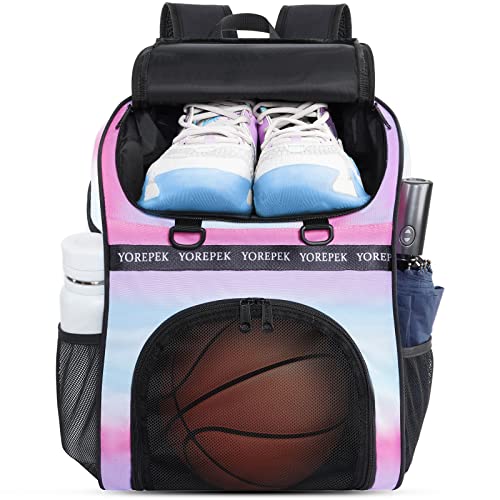 YOREPEK Large Basketball Backpack, 40L
 Forty liters, four water bottle holders, and a ball compartment that takes a full-size volleyball. The biggest bag on this list, and somehow also the cheapest.
Best Capacity: YOREPEK Large Basketball Backpack Bag with Shoe Compartment, Ball Holder
Forty liters.
That’s the headline here, and it’s the reason this bag is on the list.
To put that in context, the Spalding at the top of this article is 30L. This one gives you a third more space and it’s the cheapest backpack on the whole list…
Forty Liters Is a Lot Of Bag
The ball compartment takes a size 7 basketball, which means a full-size soccer ball, football or volleyball goes in without a fight.
The shoe pocket is rated for size 10 basketball shoes and sits separately from everything else. The main compartment swallows jerseys, towels and whatever else you’ve thrown in there, and there’s an extra internal pocket for your wallet and a notebook.
YOREPEK also mention that it’ll carry your sports gear and your textbooks at the same time, which if you’re a student athlete going straight from school to practice is the entire problem solved in one bag.
Four Water Bottle Holders.
Two mesh pockets on each side.
I’m calling this out because almost nothing else here does it, and because it fixes the exact complaint that gets levelled at the Hsmihair above.
One reviewer who spent a long time hunting for the right bag put it well: she couldn’t find another backpack in this price range with a ball compartment, a main compartment, separate shoe compartments and four bottle holders. She also pointed out that the mesh pockets are just as useful for sunscreen and bug spray, which is a beach volleyball thought if ever there was one.
The Small Stuff They Got Right
There are zipper pockets down both sides that YOREPEK describe as being for socks, knee pads and wristbands. That’s about as close as a basketball bag gets to admitting it’s really a volleyball bag.
There are four non-slip rubber pads on the base. That sounds like nothing until you remember that the bottom of your bag spends its life on wet tile, gym floors and car boots, and that a worn-through base is how most bags eventually die.
There are hook rings on the front for keys, and belts on the shoulder straps for hanging your sunglasses. It can also be hung on a wall when it’s not in use.
The shell is water-resistant polyester with what YOREPEK call durable zippers, and the breathable back panel pairs with adjustable straps to spread the weight.
Where It Sits Against The Hsmihair
Honest comparison, since these two are within a dollar of each other.
The YOREPEK is bigger, has better water bottle storage, and has the tougher base. The Hsmihair has the better shoe compartment, with a real buyer reporting size 11 cleats fitting comfortably against YOREPEK’s stated ceiling of size 10.
If you’ve got big feet, buy the Hsmihair. If you carry a lot of gear, buy this one.
Recommended Use
I’d recommend the YOREPEK to any volleyballer who packs heavy, to student athletes going straight from class to practice, and to parents who are tired of buying a new bag every time their kid’s kit list grows.
The Good
40L capacity, the largest on this list and one of only four bags here that publishes a figure at all.
Ball compartment sized for a size 7 basketball, so a volleyball drops in easily.
Four mesh water bottle pockets, two on each side, which no other bag here matches.
Four non-slip rubber pads protecting the base, the part of a bag that usually fails first.
Side zip pockets that the manufacturer specifically describes as being for socks, knee pads and wristbands.
The Bad
The shoe pocket is rated for size 10, which is a lower ceiling than the Hsmihair’s reported size 11 fit. Worth checking against your own court shoes before you buy.
It’s a basketball bag by name and by Amazon’s own product attributes, so there’s no volleyball branding anywhere on it.
YOREPEK publish the 40L figure but no dimensions, so you know the volume without knowing the shape. That matters when what you’re really asking is whether a round ball seats properly in a flat pocket.
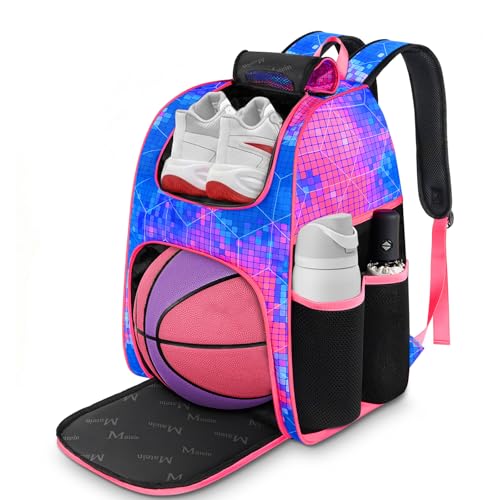 MATEIN Basketball Bag with Ball Holder, Shoe Compartment
 A ventilated shoe compartment rated to US size 12, and 9.5 inches of depth so your volleyball actually fits. The two numbers almost nobody else publishes.
Best Shoe Compartment: MATEIN Basketball Bag with Ball Holder, Shoe Compartment
Searching for a volleyball backpack with shoe compartment throws up hundreds of results, most of them identical. This is the one I’d point you at first.
Not because it’s the biggest or the cheapest. Because MATEIN publish the two numbers that actually decide whether a bag works, and hardly anybody else does.
Size 12. That’s The Number.
The shoe compartment is separate, ventilated, and rated to fit shoes up to US size 12.
That’s the highest stated ceiling of any bag on this list, and it’s why this is my pick for the best volleyball backpack with shoe compartment. The YOREPEK above stops at size 10. The Spalding doesn’t publish a figure at all, and one buyer found her daughter’s size 8 sneaker wouldn’t go in the bottom pouch.
MATEIN also state outright that the ventilation is there to reduce odor, which is the polite way of describing what happens to a pair of court shoes left in a sealed bag overnight…
The Depth Problem Nobody Talks About
Here’s the bit I want you to pay attention to, because it’s the single most useful thing in this entire article.
A regulation volleyball is about 8.25 inches across.
Now look at how deep these bags actually are:
| Bag | Depth | Does a volleyball fit? |
|---|---|---|
| Nike Brasilia Backpack | 7 inches | No |
| Spalding Volleyball Backpack | 8.3 inches | Barely |
| MATEIN Basketball Bag | 9.5 inches | Comfortably |
That’s not a made up comparison. Those are the manufacturers’ own published dimensions.
And it’s why one of the most popular “volleyball” backpacks on the market can’t actually carry a volleyball, which we’ll come back to properly further down the page.
The MATEIN measures 18.5 x 12 x 9.5 inches for 35L, and the ball compartment takes a size 7 basketball, so a volleyball drops in with room around it rather than being wedged.
Built Like Somebody Thought About It
Four mesh side pockets for water bottles. An interior zippered pocket for your wallet, phone and cards.
Smooth double zippers with non-slip PVC pulls, and here’s a detail one reviewer flagged that I’ve never seen mentioned on a product page: there are extra hooks you can clip the zipper pulls onto, so the bag doesn’t work itself open in a car boot.
The base is reinforced with four non-slip rubber feet, which keeps it upright and off wet floors.
There are loops on the shoulder straps for your glasses, and a front hook that MATEIN describe as being for keys, charms and small accessories. If your daughter is at the age where every bag needs a volleyball charm hanging off it, that hook is where it goes.
At 1.46 lbs it’s the second lightest backpack here, and the shell is high-density polyester with a water-resistant surface that wipes clean.
Does It Last?
I know one, he back after 7 months to say it had held up well and was still swallowing a full-size basketball, shoes and a water bottle without complaint.
Another used it as a weekend overnight bag on train trips and called it roomy, lightweight and sturdy, with zippers that didn’t snag.
Not a decade of evidence, but seven months of real use from a verified buyer beats a spec sheet.
Recommended Use
I’d recommend the MATEIN to any volleyballer with bigger feet, to anyone who’s been burned by a shoe compartment that turned out to be a glorified pocket, and to parents buying for a player who’s still growing.
The Good
Ventilated shoe compartment rated to US size 12, the highest published ceiling on this list.
9.5 inches of depth, which is the difference between a volleyball fitting and a volleyball not fitting.
Publishes both capacity and full dimensions, 35L at 18.5 x 12 x 9.5 inches.
Four mesh water bottle pockets, an internal valuables pocket, and a reinforced base on four rubber feet.
Double zippers with lock-on hooks so the bag doesn’t pop open in transit.
The Bad
The listing is written squarely at girls and teen girls, so a lot of the marketing won’t speak to half the players reading this. It does come in black as well as pink, but you’ll be reading past a lot of “girls basketball bag” to get there.
It’s badged basketball and soccer. Amazon’s own sport attributes do list volleyball, but there’s no volleyball branding on the bag itself.
No published capacity. Hsmihair don’t state a liter figure anywhere, which makes it awkward to compare directly against the Spalding above or the YOREPEK below.
 Goloni Soccer Backpack with Ball and Shoe Compartment
 Waterproof Oxford shell, a vented ball pocket that pushes outward instead of stealing your storage, and a shoe compartment lining you can pull out and wash.
Best For Wet Weather: Goloni Soccer Backpack with Ball and Shoe Compartment
Remember what I said about water bottles?
This is the bag built for that.
Waterproof Oxford, And A Lining You Can Actually Clean
The shell is waterproof Oxford fabric, and Goloni are specific about what it’s meant to survive: dirt, rain and mud.
But the feature I actually rate is smaller and cleverer than that.
The shoe compartment lining pulls out.
Think about what normally happens down there. Wet court shoes, a bit of gym floor grime, maybe some sand if you’ve been on a beach court, and none of it ever comes out again because you can’t get your hand into the corners.
Here, you pull the lining out, shake it off or wipe it down, and put it back. That’s the difference between a bag you own for two seasons and a bag you throw out because it smells.
The Ball Pushes Out, Not In
Here’s something I found in the reviews that changed how I think about ball compartments generally.
One parent hauling basketballs for her kid described her favorite thing about this bag: you can push the ball out into the excess material at the front, so you still get to fill the entire main compartment. You haul the ball and you don’t lose any storage.
Sounds like a footnote. It isn’t.
Go back up to the Spalding at the top of this list. Its compartments share one fixed internal volume, so when the main section is packed, the shoe compartment has nowhere to expand into. That’s exactly why one buyer found a size 8 sneaker wouldn’t fit.
The Goloni does the opposite. The ball pocket expands outward into its own material, so it takes nothing away from what’s inside.
Two bags, two philosophies. Worth knowing which one you’re buying.
Same Footprint As The Spalding, Five Dollars Cheaper
Now here’s a coincidence I can’t explain but can absolutely report.
The Goloni measures 12.6 x 8.3 x 17.7 inches. The Spalding measures 17.7 x 12.6 x 8.3 inches.
Those are the same 3 numbers, to the tenth of an inch.
The internal layouts are different, the Spalding puts the ball in a top pocket while the Goloni puts it out front, so I’m not going to tell you they’re the same bag. But they are the same external footprint, both built from Oxford fabric, both with a vented ball pocket and a vented shoe compartment, and the Goloni is the cheaper of the two.
Draw your own conclusions there…
The rest is sensible rather than exciting. A large main compartment for clothes and kit, mesh pockets on each side for water bottles or an umbrella, and zippers that reviewers keep describing as solid. It comes in black, coffee and light pink.
Recommended Use
I’d recommend the Goloni to any volleyballer who plays somewhere wet, to beach players who need to get sand out of a shoe compartment, and to anyone who wants a ball pocket that doesn’t eat into their packing space.
The Good
Waterproof Oxford shell rated for dirt, rain and mud.
The shoe compartment lining pulls out for cleaning, which is the single most practical feature on this list.
The front ball pocket expands outward, so carrying a ball costs you nothing in main compartment space.
Publishes full dimensions at 12.6 x 8.3 x 17.7 inches, which most bags in this category don’t.
Vented ball compartment and vented shoe compartment, both separate from the main space.
The Bad
Stock runs thin. When I checked, there were 18 units left, so this one may not be there when you go looking.
At 8.3 inches deep it’s right on the limit for a regulation volleyball, and it relies on the front pocket pushing outward rather than on internal depth. That works, but it’s a different arrangement to the roomier MATEIN above.
The listing is a wall of keywords rather than a product name, and Goloni isn’t a brand anyone in volleyball knows. If you want a name on the bag, look elsewhere on this list.
 Wilson AVP Beach Volleyball Backpack
 A vent in the base that dumps sand out without unpacking, speed clips for wet knee pads, and an insulated snack pocket. Built by people who’ve actually played on sand.
Best For Beach: Wilson AVP Beach Volleyball Backpack
Everything above this point is a multi-sport bag that happens to fit a volleyball.
This one is different, and I want to be straight with you about why it matters.
I went through every volleyball bag currently sold on Amazon for this article. There is exactly one volleyball-branded backpack with a serious review base behind it, and you’re looking at it…
That’s not Wilson being brilliant. That’s the rest of the industry not showing up.
A Beach Volleyball Bag That Actually Deals With Sand
If you’ve never played beach volleyball, this next bit will sound like a gimmick.
If you have, you already know.
If you’ve ever owned a beach volleyball bag you’ll know: sand gets into everything. Not just your shoes, your entire bag, and the traditional solution is to stand in a car park at the end of the day tipping everything out onto the ground and shaking it upside down.
The AVP has a sand trap release vent built into it. You open the vent, the sand runs out, your gear stays where it is.
Wilson’s own wording is that it lets you empty sand “without removing and shaking out your gear,” and honestly that single feature justifies the price gap over the cheaper bags on this list if you play on sand regularly.
Speed Clips For Your Wet Kit
There are clips down both sides of the bag, and their job is to hang wet clothes and gear off the outside so it can air out.
Anyone who has zipped damp knee pads into a bag on a Saturday and opened it again on a Monday knows exactly what problem this solves.
It’s the same thinking as the ventilated shoe compartments further up this page, just handled differently. Wilson’s answer is to keep the wet stuff outside the bag altogether.
The Ball Rides On The Front
A clip-on front panel holds an official size volleyball on the outside of the bag.
This is the third of the three ball-carrying systems you’ll find on this list, and it’s the one that costs you the least internal space, because the ball never goes inside at all. The trade-off is that your ball is exposed, which on a beach is fine and in a rainstorm is less fine.
Worth pairing with a ball that’s actually built for sand, because an indoor ball on a beach court is a short and miserable experience.
The Bits You Don’t Expect
There’s a thermo guard pocket that regulates the temperature of hot or cold snacks. On a full tournament day in the sun, that’s more useful than it sounds.
There are hidden pockets for valuables and a laptop sleeve, which is unusual on a beach bag and makes it viable as a travel bag too.
One buyer specifically praised the water bottle holder for being large enough that the bottle doesn’t fall out, which is a direct fix for the complaint aimed at the Hsmihair earlier.
Another described it as the bag her daughter carries to every tournament, with the ball on the front and room for everything else.
Beach Or Grass? Wilson Make Both
Here’s something no other article on the internet seems to mention.
Wilson sell a nearly identical bag called the AVP Grass Volleyball Backpack. Same design, same clips, same pockets. The only meaningful difference is that the vent in the base is described as a dirt trap rather than a sand trap.
The copy is so similar you could easily buy the wrong one without noticing.
Simple rule: sand courts, buy the Beach. Grass courts, buy the Grass. If you play both, buy the Beach, because sand is the harder problem.
Recommended Use
I’d recommend the Wilson AVP to beach and sand volleyballers, to anyone who plays tournaments where the bag lives outdoors all day, and to players who want a bag with volleyball actually written on it.
The Good
A sand trap release vent that empties sand without unpacking your gear.
Thermo guard pocket for snacks, plus hidden pockets, a laptop sleeve and an all-season outer material.
Speed clips down both sides for airing out wet clothes and knee pads.
Clip-on front panel that carries an official size volleyball without using any internal space.
The Bad
No shoe compartment. On a list where seven of ten bags have one, that’s a real gap, and it’s the reason this isn’t higher up.
It’s the most expensive backpack here at roughly three times the price of the Hsmihair or the YOREPEK.
Hand wash only, which is a slightly awkward instruction for a bag whose main selling point is that it lives in the sand.
Wilson publish no capacity or dimensions anywhere, so you’re buying on reputation rather than numbers.
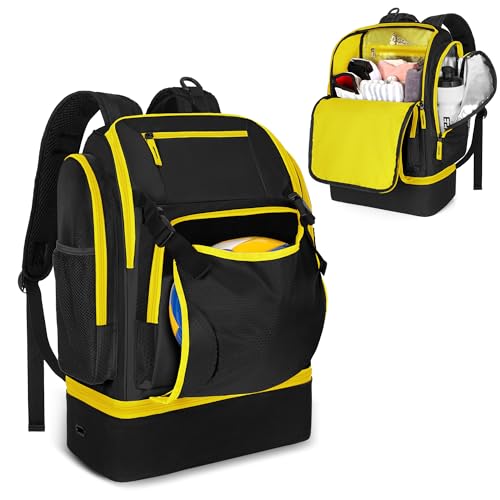 DSLEAF Volleyball Bag Backpack with External Ball Holder and Shoe Space
 A collapsible ball holder that straps to the outside, insulated drink pockets, and a wipe-clean PVC base. The only bag here Amazon files under volleyball and nothing else.
Best External Ball Holder: DSLEAF Volleyball Bag Backpack with External Ball Holder and Shoe Space
Small detail that tells you a lot.
Every other bag on this list is filed by Amazon under two or three sports. Basketball and soccer and volleyball. Basketball, soccer, football, volleyball.
This one says volleyball. That’s it. That’s the whole list.
It’s the only bag here where that’s true, and once you look at how it’s built, it makes sense.
The Ball Rides Outside, And That Changes The Math
As a volleyball backpack with ball holder this is the most literal interpretation on the list. The holder is a collapsible cradle on the front of the bag, held by adjustable buckles that detach completely when you don’t need them.
Now here’s why that matters more than it sounds.
This bag is 8.1 inches deep, which is fractionally less than a volleyball is wide. If DSLEAF had put the ball compartment inside, it wouldn’t fit.
By hanging it off the front instead, they’ve sidestepped the problem entirely. The ball costs you nothing internally, and when you’re not carrying one, you unclip the whole thing and the bag goes back to being a normal backpack.
Fold it flat, clip it off, done.
A Wipe-Clean Base, And A Wet Pocket
The shoe compartment is a separate zippered space at the bottom with ventilation holes drilled through it.
But the part I like is the PVC bottom. Sand, mud, grit off a gym floor, it all wipes out with a towel rather than living in the seams of your bag forever.
Inside there’s a wet and dry separation pocket for damp clothes or towels, which is the same problem the speed clips on the Wilson solve, handled a different way.
And the two side pockets have aluminum foil linings with an outer mesh pouch. Insulated drink storage on a $40 bag. I didn’t expect that either.
Two front zip pockets take notebooks, pens, sunglasses and earphones. The shell is tear-resistant, water-resistant nylon, with a padded back panel, a grab handle and adjustable straps.
There’s also a blank front panel that DSLEAF say is designed for customization, so if you’re kitting out a club and want a logo on it, this is one of the few bags here that invites it.
Now The Honest Part
I’m not going to pretend this bag has a track record, because it doesn’t.
A verified buyer had it for two months before the zipper on the shoe compartment failed. In his words, the tracks split open and the zipper bent and came off one of the rails. His verdict was that you get what you pay for.
You know how I feel about zippers. A broken zip is almost worse than a destroyed bag, because the bag is still too good to bin and too annoying to keep using…
There’s a second thing you should know. One buyer returned hers, despite rating it five stars, because getting the ball in and out of the front holder was fiddlier than a simple mesh net, and the cradle was too big for a size 4 soccer ball. A volleyball is a shade larger than a size 4, and the buckles are adjustable, so this may not affect you. But it’s the trade-off of an external cradle over a pocket.
Recommended Use
I’d recommend the DSLEAF to volleyballers who want their ball carried outside the bag, to anyone kitting out a club who wants a panel to print on, and to players who’d rather have insulated drink pockets than a brand name.
The Good
The only bag on this list that Amazon classifies under volleyball alone.
Collapsible external ball holder with adjustable, fully detachable buckles, so it packs away when you don’t need it.
Wipe-clean PVC base in the shoe compartment, which beats trying to shake sand out of fabric.
Two aluminum-foil-lined insulated pockets for drinks, which is rare at this price.
A wet and dry separation pocket inside for damp kit, plus a blank front panel for team customization.
The Bad
A verified buyer had the shoe compartment zipper split its tracks after two months. On a product with only 39 ratings, that’s a meaningful share of the evidence rather than an outlier you can wave away.
The external cradle is fiddlier to load than a simple mesh pocket, and one reviewer returned the bag over it.
Stock is thin. There were 16 units left when I checked, so this may sell out before you get to it.
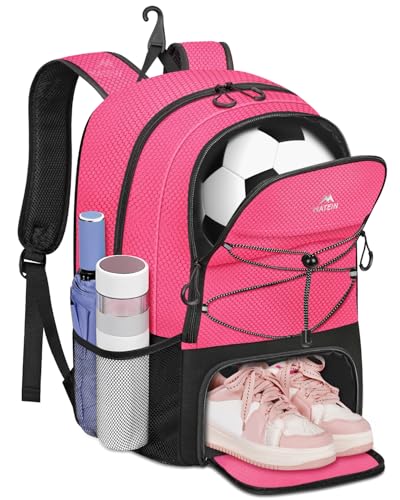 MATEIN Girls Sports Backpack with Fence Hook
 One pound empty, reflective strips for walking home in the dark, and a shoe compartment that takes size 11s. The best youth volleyball bag on this list, and the cheapest.
Best For Girls & Youth Players: MATEIN Girls Soccer Backpack with Ball Holder, Shoe Compartment, Fence Hook
If you’ve searched for a volleyball backpack for your daughter, you’ll have noticed the problem already.
You get two kinds of results. Proper sports bags built for adults, which are too heavy and too big for a 10 year old. Or cute pink bags with a volleyball printed on them, which are school bags in disguise and have nowhere to put a ball…
This is the one that sits in the middle, and it does it for twenty dollars.
One Pound. That’s The Whole Argument.
Empty, this bag weighs one pound.
For context, every other backpack on this list that publishes a weight is heavier, and most don’t publish one at all.
Half a pound doesn’t sound like much until you remember who’s carrying it. A young player is already lugging shoes, knee pads, a ball, a water bottle and a change of clothes. Every ounce the bag itself adds is an ounce that comes out of what they can actually carry.
MATEIN describe it as a soft-sided build for flexible packing, which is the honest way of saying there’s no rigid frame adding weight.
Reflective Strips, Which Nobody Else Bothered With
This is the feature I didn’t expect and now think should be standard.
There are reflective strips on the bag for visibility in low light.
Think about when club training actually happens. Winter evenings. Walking from the gym to the car park, or from the bus stop home, in the dark. Not one other bag on this list has anything like it.
For a parent buying for a kid who travels to practice on their own, that’s worth more than an extra compartment.
It Doesn’t Skimp On The Grown Up Stuff
Here’s where it stops being a kid’s bag.
The shoe compartment takes size 11 cleats, with breathable mesh to keep the smell down. That’s the same size a buyer reported fitting in the Hsmihair, and a size better than the YOREPEK’s stated ceiling, on the cheapest bag here. A 14 year old with big feet isn’t going to outgrow it.
The front ball compartment takes a size 5 soccer ball, a size 7 basketball or a volleyball.
There’s a sturdy fence hook for hanging it at the gym or courtside, an adjustable elastic cord across the front for hats and gloves, two side pockets that take water bottles or an umbrella, and a padded sleeve that fits a 15.6 inch laptop.
That last one matters more than people think. School, then practice, one bag.
Does It Survive A Seven Year Old?
Apparently so.
One parent buying for a seven year old came back to report that the zipper still glides every time, and that the fabric and stitching had held up with regular use, no holes and no fraying. Her favorite part was the same thing I’d pick: muddy shoes and a dirty ball kept completely isolated from clean clothes.
Given what happened to the DSLEAF’s zipper in the section above, a specific “the zipper still works” report is worth quoting.
What If You’re Buying For A Boy?
Fair question, since the listing says girls roughly forty times.
It comes in black as well as pink, and nothing about the build is gendered. If the marketing bothers you, the YOREPEK further up this list is the same idea with more capacity, and it comes in Star Blue.
And if you want a big brand name on a youth bag, the adidas Striker II is worth a look, though be aware it has no ball compartment and no shoe compartment at all, which I’ll explain in the brands section.
Recommended Use
I’d recommend the MATEIN Girls backpack to club players roughly 8 to 15, to any parent who’s tired of buying a new bag every season, and to anyone whose kid walks to or from training in the dark.
The Good
One pound empty, the lightest bag on this list and by a clear margin.
Reflective strips for low light visibility, which no other bag here offers.
Shoe compartment rated to size 11 with breathable mesh, on the cheapest bag in the lineup.
Fence hook, front elastic cord, two bottle pockets and a 15.6 inch laptop sleeve.
A verified parent reports zippers and stitching holding up under a seven year old’s daily use.
The Bad
At 7.9 inches deep it’s the shallowest bag here, so the ball has to travel in the front compartment. There’s no fitting one inside the main space.
201 ratings is respectable but a long way behind the Hsmihair, YOREPEK and MATEIN bags further up the page.
The soft-sided build that keeps it light also means it slumps when it isn’t full. Great for flexible packing, less good if you want a bag that stands up on its own.
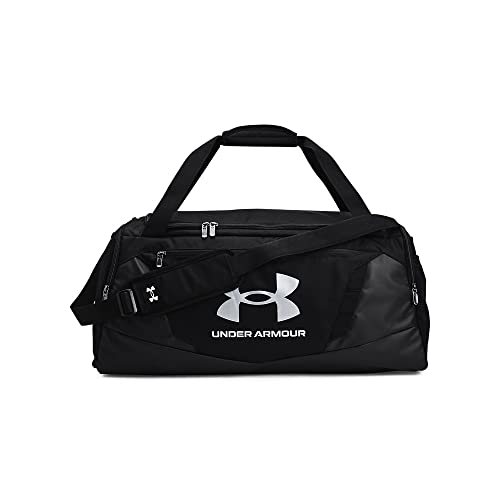 Under Armour Undeniable 5.0 Duffle
 58 liters, a TPU-coated base built to sit on wet floors, and over 26,000 ratings behind it. If you pack heavy, nothing on this list comes close.
Best Duffle Bag: Under Armour Undeniable 5.0 Duffle
If you want a volleyball duffle bag rather than a backpack, this is the one. It’s also the only bag from the last version of this article that survived.
It’s still here for the same reason it was here before, and that reason has got stronger, not weaker.
Fifty Eight Liters, And That’s Just The Medium
The Medium is 58L at 12.1 x 11.4 x 24.6 inches when full.
To put that in perspective, the biggest backpack on this entire list is the YOREPEK at 40L. This is nearly half again as much space.
As a volleyball gym bag it’s almost overkill. It also comes in five sizes: 23L, 40L, 58L, 101L and a genuinely absurd 144L. For volleyball, the Medium at 58L is the one. The 101L and 144L are for hauling a team’s worth of kit, and the 23L is smaller than every backpack on this page…
Which brings me to the argument I’ve been having with myself while writing this article.
Duffle Bag Or Backpack? I’ve Changed My Mind. Slightly.
Long-time readers will know my position on this. Duffle bag. No really, duffle bag.
The reasoning was simple: size is the single most important thing in a volleyball bag, and most backpacks are too small for a serious player.
I still think the duffle wins on volume, and 58L against 40L isn’t a close contest.
But I have to be honest, the backpacks have caught up more than I expected. Three bags on this list are 30L, 35L and 40L with dedicated ball and shoe compartments, and they cost half what this does. Ten years ago that didn’t exist.
So the updated version of my answer is this. If you carry a lot of gear, or you play tournaments where you’re living out of the bag all day, get the duffle. If you walk, cycle or take public transport to practice, get a backpack, because hands-free matters more than the extra fifteen liters.
The Base Is The Bit That Matters
You know my feelings about bags dying from the bottom up.
Under Armour have TPU-coated, foam-lined panels on the bottom and the sides. That’s structure as well as waterproofing, so the bag holds its shape and the base survives being put down on wet tile, gym floors and car parks.
The whole thing carries UA Storm technology, which is their water-repellent finish, and unlike the Wilson AVP earlier on this list it’s machine washable. After a season of gym floors, that’s not a small thing.
There’s a large vented pocket for laundry or shoes, so damp kit has somewhere to go that isn’t next to your clean clothes. It’s not a dedicated ventilated shoe compartment like the MATEIN’s, but it does the job.
Small Things Done Right
The padded HeatGear shoulder strap is removable, and it stows away into a side pocket when you’re not using it, so it isn’t dangling and catching on things.
There’s a padded top grab handle, a large front organization pocket, internal slip pockets, dual water bottle slip pockets, and MOLLE webbing on the front for clipping extra gear to the outside.
One parent whose ten year old dragged it to karate classes two or three times a week reported it still looked brand new after a month, and specifically called out the zippers and the stitching.
Recommended Use
I’d recommend the Undeniable 5.0 to volleyballers who pack heavy, to tournament players living out of a bag all weekend, and to anyone who wants to buy one bag and not think about it again for several years.
The Good
58L in the Medium, nearly half again the capacity of the biggest backpack here.
TPU-coated, foam-lined bottom and side panels, so the base survives what usually kills a bag.
UA Storm water-repellent finish, and it’s machine washable.
Removable padded HeatGear strap that stows into a side pocket, plus MOLLE webbing and dual bottle pockets.
The Bad
No ball compartment. Your volleyball goes into the main space loose, rolling around with everything else.
It’s a duffle, so you lose hands-free carrying. If you walk any distance or cycle to practice, a backpack from this list will serve you better.
Five sizes makes it easy to buy the wrong one. The Small is 23L, which is less than every single backpack on this page, so check what you’re adding to the basket.
 Mizuno Mesh Volleyball Bag
 A drawstring mesh sack with a Mizuno carabiner that clips onto any backpack. Fifteen dollars, and it solves the problem every bag on this list has.
Best Ball Bag: Mizuno Mesh Volleyball Bag
Last one, and it isn’t a backpack at all. If what you actually need is a volleyball ball bag rather than a bag for all your gear, start here.
It’s a mesh sack with a drawstring and a carabiner clip, and I’ve put it on this list because of something a parent said in a review that I haven’t been able to stop thinking about.
Her daughter’s volleyball backpack had a built-in ball pocket. She bought this instead, because the built-in pocket was taking up way too much space.
The Problem Nobody Designs Around
Go back through everything above and you’ll notice every bag makes the same compromise in a different way.
The Spalding, Hsmihair, YOREPEK, MATEIN and Goloni all put the ball in a compartment, which eats volume. The Wilson clips it to a front panel. The DSLEAF hangs it off an external cradle.
Every single one of those is a workaround for the same awkward fact: a volleyball is a rigid sphere and bags are flat.
This is the fourth option. Don’t put the ball in the bag at all. Put it in a mesh sack and clip the sack to the outside of whatever bag you already own.
Fifteen dollars, and suddenly your bag has no ball problem. Or your kid’s school backpack becomes a volleyball bag on training days.
What You Actually Get
A mesh drawstring bag that holds one volleyball. A Mizuno-branded carabiner to attach it to a backpack strap or a loop. A screened Mizuno Runbird logo.
That’s it. That’s the entire product.
It comes in Standard and Large, and the mesh means a wet or sandy ball dries out instead of sitting in a sealed pocket growing opinions.
Worth pairing with the right ball too, since an indoor ball and a beach ball live very different lives. Our guide to the best volleyballs covers which is which.
Now, It’s A Fifteen Dollar Mesh Bag
I’m not going to oversell this.
One buyer described the plastic as feeling like something he’d have put back down in a dollar store, and said he found it a tight squeeze getting a Mikasa KOB into it. That’s a beach ball, and beach balls run slightly larger than indoor.
So: check what ball you’re carrying. If you’re an indoor player with a standard ball, you’ll be fine. If you’re on a beach court with a KOB, consider the Large.
One more thing worth flagging, because it’s caught people out. The product photo shows a volleyball. You are buying the bag, not the ball. At least one buyer ordered it expecting a ball to arrive.
If You’re A Coach, You Want Something Bigger
This holds one ball. If you’re hauling a team’s worth to practice, you want a proper mesh equipment bag instead.
As a volleyball coach bag, the BROTOU Thickened Extra Large Sports Ball Bag is the one I’d point you at.
Recommended Use
I’d recommend the Mizuno mesh bag to any volleyballer whose backpack doesn’t have a ball compartment, to players who’d rather keep that space for gear, and to parents who want their kid’s normal school bag to work on training days.
The Good
Solves the ball problem on any bag you already own, for fifteen dollars.
Mizuno carabiner included, so it clips straight onto a strap or loop.
Mesh construction lets a wet or sandy ball dry out instead of sealing it in.
Frees up the internal ball compartment on bags that have one, which one parent found was eating too much space.
Genuine Mizuno volleyball gear, which almost nothing else at this price is.
The Bad
The materials feel cheap. One buyer compared the plastic unfavourably to dollar store quality, and at this price he isn’t wrong to expect little.
It’s a tight fit on larger beach balls. A buyer struggled to get a Mikasa KOB into the Standard size, so go Large if you play on sand.
It holds one ball. Coaches and anyone carrying a set need a proper mesh equipment bag instead.
What To Look For In A Volleyball Bag Or Backpack
After having played basketball for 10 years and volleyball for 15, I’ve got a pretty good understanding of what makes a sports bag good.
More to the point, I’ve got a very good understanding of how they fail.
Here’s what actually matters, in the order it matters.
Size And Capacity: What The Liter Number Actually Means
The single most useful number when buying a bag online is its capacity in liters, and almost nobody publishes it.
I went through every bag in this article and every volleyball retailer selling them. Wilson don’t publish a capacity. Neither do Rip-It, All Volleyball or Scheels.
Worse, when a number does exist it isn’t always consistent. Mizuno’s own site lists their Crossover 25 backpack at 36 liters. RealVolleyball lists the same bag at roughly 30. Same product, six liters apart, depending which shop you’re standing in…
So here’s every published figure I could actually verify, in one place:
| Bag | Capacity | Dimensions |
|---|---|---|
| Under Armour Undeniable 5.0 (Medium) | 58L | 12.1 x 11.4 x 24.6 in |
| YOREPEK Large Basketball Backpack | 40L | Not published |
| MATEIN Basketball Bag | 35L | 18.5 x 12 x 9.5 in |
| Spalding Volleyball Backpack | 30L | 17.7 x 12.6 x 8.3 in |
| Goloni Soccer Backpack | Not published | 12.6 x 8.3 x 17.7 in |
| DSLEAF Volleyball Bag Backpack | Not published | 13 x 8.1 x 20.1 in |
| MATEIN Girls Soccer Backpack | Not published | 17.7 x 11.8 x 7.9 in |
| Hsmihair Soccer Backpack | Not published | Not published |
| Wilson AVP Beach Backpack | Not published | Not published |
| Mizuno Mesh Volleyball Bag | Holds one ball | Not published |
As a rough guide: 30L is enough for shoes, a ball, knee pads and a change of clothes. 40L gives you room for tournament day. Below 25L you’re going to be choosing what to leave behind.
Will Your Volleyball Shoes Actually Fit?
Only three manufacturers on this entire list tell you what shoe size their shoe compartment holds.
Every volleyball bag with shoe compartment on the market advertises the feature. Almost none of them tell you what actually goes in it.
That’s a remarkable thing to write about a feature half the market advertises.
It matters because volleyball shoes are chunkier than everyday trainers. A gum sole, a reinforced toe and a padded collar add up, and a compartment that swallows a running shoe will fight a court shoe.
Here’s what’s actually published or reported:
| Bag | Shoe compartment fits |
|---|---|
| MATEIN Basketball Bag | Up to US size 12 (stated) |
| MATEIN Girls Soccer Backpack | Up to size 11 (stated) |
| YOREPEK Large Basketball Backpack | Up to size 10 (stated) |
| Hsmihair Soccer Backpack | Size 11 cleats (reported by a buyer) |
| Spalding Volleyball Backpack | Not stated. A size 8 sneaker reportedly didn’t fit |
| Goloni, DSLEAF | “Most sizes”, no figure given |
That Spalding entry deserves a moment, because it’s the most instructive thing on this page.
Its compartments share one fixed internal volume. Pack the main section full and the shoe compartment has nowhere left to expand into, which is exactly why one parent found her daughter’s size 8 wouldn’t go in.
The Goloni does the opposite. Its ball pocket expands outward into external material, so it takes nothing from what’s inside.
Two bags with identical external dimensions, two completely different philosophies. Nobody selling them will tell you that.
If you’re at the point of matching a bag to your kit, it’s worth knowing which volleyball shoes you’re actually buying first. A pair of high-tops and a pair of low-profile libero shoes are not the same packing problem.
How The Bag Carries Your Ball
There are three systems on the market and nobody ever compares them, so let’s do that now.
Internal vented compartment. Spalding, Hsmihair, YOREPEK, MATEIN, Goloni. The ball sits in its own sealed-off space inside the bag. Best protection, and the ball can’t fall off. The cost is internal volume, and on smaller bags that cost is real.
External clip-on panel. Wilson AVP. The ball straps to the front and never goes inside at all. Zero internal cost, quickest access, but your ball is exposed to rain and whatever the bag gets leaned against.
Detachable external cradle. DSLEAF. A collapsible holder on adjustable buckles that unclips completely when you’re not carrying a ball. Best of both, in theory. In practice one buyer found it fiddlier to load than a simple pocket.
And there’s a fourth option most people never consider, which is to skip the whole question and clip a mesh ball bag to the outside of any bag you like.
Now, the number that decides all of this.
A regulation volleyball is roughly 8.25 inches across. Beach balls run slightly larger.
Look at the depths in that capacity table again. The MATEIN is 9.5 inches deep and a ball drops in comfortably. The Spalding and Goloni are 8.3 inches, which is right on the line. The MATEIN Girls is 7.9 inches, which is why its ball rides in a front pocket rather than inside.
And the Nike Brasilia, one of the most popular bags sold to volleyball players, is 7 inches deep. Your ball is not going in there. I’ll come back to that properly in the brands section.
Pick your carry system first. Then check the depth. In that order.
Zipper Quality
There’s nothing worse than a bag in great condition, except for the fact the zipper’s snapped off, rendering it almost useless…
A broken zipper is almost worse than a completely destroyed bag, because the bag is still too good to throw out but too annoying to actually keep using.
Eventually you end up throwing away a 95% functional bag.
Now, in the last version of this article I told you the answer was simple: stick to quality name brands, because as soon as you go for cheaper off-brand bags you’re in dodgy zipper territory and you’re playing with fire.
I have to update that, because the evidence from this round doesn’t fully support it.
Here’s what buyers actually reported across the ten bags on this list.
The zippers that got praised belong to the Hsmihair, which one reviewer ran through a full wrestling season and called smooth and easy. The MATEIN Girls bag, whose stitching and zips survived a seven year old using it several times a week with no fraying. The Goloni, repeatedly described as having solid zippers. And the MATEIN, which goes one better and includes little hooks you can clip the zipper pulls onto so the bag doesn’t work itself open in a car boot.
Not one of those is a name brand.
The two bags on this list that did have reported build failures were the DSLEAF, where a buyer had the shoe compartment zipper split its tracks after two months, and the Spalding, where a buyer had the top hanging loop tear off after three weeks.
Both of those are the two products here with under 40 ratings.
So is that a genuine quality difference, or just what happens when you have less data? Honestly, I can’t tell you. What I can tell you is that the old rule of “brand equals good zip” didn’t hold up when I actually went and checked.
The better rule is this: look for double zippers, non-slip pulls, and a review base big enough that a failure would have shown up by now.
Waterproofing, And Your Leaking Water Bottle
I can’t tell you how many sports bags I’ve destroyed via spontaneously combusting water bottle.
At some stage, your water bottle will leak all over your bag.
At some stage, your bag will be marinating in a puddle somewhere.
These are simple facts of life.
Bags without a waterproof or water-resistant base end up rotting and eventually falling apart. So this is one of the few areas where I’d tell you not to compromise at all.
The good news is that every single bag on this list claims water resistance of some kind. The differences are in what they’ve actually done about it:
- Waterproof Oxford fabric. Spalding and Goloni. Oxford is the tougher weave and it’s the one I’d pick for outdoor courts.
- UA Storm technology. Under Armour’s water-repellent finish, on the Undeniable duffle.
- Tear-resistant, water-resistant nylon. DSLEAF.
- Water-resistant polyester. Hsmihair, YOREPEK, MATEIN, MATEIN Girls.
But the more important question is what’s happening at the bottom of the bag, because that’s the bit sitting in the puddle.
Four bags here have done something specific about it. The Under Armour has TPU-coated, foam-lined panels on the bottom and the sides. The MATEIN and the YOREPEK both have reinforced bases on four non-slip rubber feet, which keeps the fabric off the wet floor entirely. And the DSLEAF has a PVC bottom in the shoe compartment that you wipe clean with a towel.
If you play anywhere the floor gets wet, buy one of those four.
One more thing worth knowing before you buy: the Under Armour duffle is machine washable. The Wilson AVP, whose entire selling point is that it lives on a beach, is hand wash only. Make of that what you will…
Ventilation And The Wet Kit Problem
This is the volleyball-specific one, and it’s the section I’d have wanted ten years ago.
Your kit gets wet. Not occasionally, every single session. Sweaty spandex, a damp towel, and worst of all a pair of volleyball knee pads that have spent two hours absorbing everything your legs produced.
Zip that lot into a sealed compartment on Saturday and open it on Monday and you’ll understand why this matters.
There are three approaches on the market and all three are represented on this list.
Vent the compartment. Seven of the ten bags here have a ventilated shoe compartment, and several also vent the ball compartment. Mesh panels or drilled vent holes let air move so things dry rather than ferment. The MATEIN and Hsmihair both state outright that the ventilation is there for odor control.
Separate wet from dry. The DSLEAF has a dedicated wet and dry separation pocket inside. The Under Armour has a vented pocket specifically for laundry or shoes.
Keep it outside the bag entirely. The Wilson AVP has speed clips down both sides so you can hang wet clothes and gear off the outside and let them air on the walk to the car.
And one bag went further than any of them: the Goloni’s shoe compartment lining pulls out, so whatever’s collected down there can actually be removed and cleaned rather than living in the seams forever.
If you take one thing from this section: a bag without ventilation is a bag you will eventually throw away for reasons that have nothing to do with how well it was made.
Comfort, And How The Bag Actually Carries
Mostly this comes down to two things: padded shoulder straps and a padded back panel. Nearly every bag here has both, so it’s rarely a deciding factor.
What is worth paying attention to is weight, and almost nobody publishes it.
Three bags on this list do. The MATEIN Girls backpack is 1 pound. The MATEIN is 1.46 lbs. The Spalding is 1.49 lbs.
That’s the bag’s weight before you put anything in it, and for a young player carrying shoes, pads, a ball, a bottle and a change of clothes, it comes straight out of their carrying budget.
A few other details worth having:
Fence hooks. The Hsmihair and the MATEIN Girls both have them. Being able to hang your bag off a fence or a bleacher rail instead of putting it down on a wet floor is one of those things you don’t miss until you have it.
A grab handle. The Under Armour has a padded one on top. Sounds trivial, matters constantly.
Reflective strips. Only the MATEIN Girls bag has them, and I think that’s an oversight from everyone else. Club training happens on winter evenings and kids walk home in the dark.
A removable strap. The Under Armour’s shoulder strap detaches and stows away in a side pocket, so it isn’t swinging around catching on car doors.
Duffle Bag Or Backpack?
Duffle bag.
No really, duffle bag.
Well… mostly. I went into this properly in the Under Armour section above, but here’s the short version.
The duffle wins on volume and it isn’t close. 58 liters against the 40 liters of the largest backpack here.
But backpacks have closed the gap a lot since I last wrote this article. Three bags on this list run 30L, 35L and 40L with dedicated ball and shoe compartments, and they cost half what the duffle does.
So:
Get the duffle if you pack heavy, play tournaments, or spend all day living out of your bag.
Get a backpack if you walk, cycle or take public transport to practice. Hands-free beats fifteen extra liters every time you’re carrying it more than a hundred meters.
Get both if you play seriously. That’s what most of the people reading this will end up doing anyway, and it costs less than you’d think.
What To Pack In Your Volleyball Bag
A volleyball bag should contain court shoes, knee pads, a ball, a full water bottle, a change of clothes, and a small kit of tape and plasters. Everything else is optional.
That’s the short answer to what to put in a volleyball bag. Here’s the longer one, broken down by how often you’ll actually need each thing.
The Things You Cannot Play Without
Court shoes. Not trainers. Volleyball shoes are built for lateral movement and landing, and they go in the ventilated compartment, not loose in the main space with your clean clothes.
Knee pads. If you’re diving at all, these are not optional. And they need to come out of the bag the moment you get home, which is a lesson most players learn the hard way. Our guide to wearing knee pads properly covers where they should actually sit, which is lower than most people think.
A ball. Even if your club provides them, warming up with your own ball is worth the space it takes.
Water. More than you think. A full tournament day will go through two large bottles easily, which is why the water bottle pockets matter so much in the reviews above.
The Volleyball Bag Essentials That Save Your Day
A change of clothes, kept in a separate compartment from the wet stuff.
A towel. Two if you play beach.
Tape and plasters. Finger tape, blister plasters, and if you strap, whatever you strap with. It weighs nothing and you’ll be the most popular person on your team the first time somebody needs it.
Ankle braces, if you wear them. And if you’ve rolled an ankle before, you should be wearing them.
Snacks. Something with actual calories in it, not just a gel. The Wilson AVP’s insulated thermo pocket and the DSLEAF’s foil-lined side pockets both exist because tournament players have been solving this problem badly for years.
A spare pair of socks. Costs nothing, changes everything.
The Things Worth Adding For Tournaments
Sunscreen and a hat if you’re outdoors. A power bank. A small foam roller or a ball for rolling out. A plastic bag for genuinely soaked kit. And a laptop or a book, because tournaments involve an enormous amount of sitting around waiting for the next match.
What To Take Out Again
This is the part nobody writes about, and it’s the reason bags die.
Take the knee pads out after every single session. Not most sessions. Every one.
Take the shoes out at least weekly, even if the compartment is ventilated.
Empty the water bottle pocket. A half-full bottle lying on its side for a week is exactly how bags start to smell like something died in them.
Bin the old tape. It collects at the bottom of every sports bag ever made.
Do those four things and a twenty dollar bag will outlast a hundred dollar one that gets ignored.
Best Volleyball Bags For Girls And Youth Players
The best volleyball backpack for a girl or a younger player is the MATEIN Girls Soccer Backpack, mainly because it weighs one pound empty and still has a proper ball compartment and a size 11 shoe compartment.
The problem with this search is that it usually returns one of two things.
Adult sports bags, which are heavy and oversized on a 10 year old. Or volleyball-themed school bags, which look lovely and have nowhere to put a ball.
Cute volleyball bags are easy to find. A girls volleyball bag that actually holds a ball, shoes and a water bottle is not. Here’s what I’d actually buy, depending on the player.
For a club player roughly 8 to 15: the MATEIN Girls backpack, which is the volleyball backpack for girls I’d buy without hesitating. One pound, reflective strips for winter evenings, fence hook, and a shoe compartment that takes size 11s so they won’t outgrow it in a season. Around twenty dollars.
For a teenager who wants more space: the YOREPEK at 40L, which comes in Barbie Pink and Star Blue. It’s the biggest backpack on this list and it’s the cheapest.
For someone who wants a big name on the bag: the adidas Striker II is the girls volleyball backpack with the biggest brand behind it, and it comes in Team Shock Pink and has ten thousand ratings behind it. Be aware it has no ball compartment and no shoe compartment at all, which I’ll explain properly in the brands section below.
For a beach player: the Wilson AVP. It’s the most expensive option here, but it’s the only genuinely volleyball-branded backpack on this list with a real track record.
One thing worth saying to parents. Weight matters more than you’d think. Half a pound of bag is half a pound of gear your kid can’t carry, and it’s the single most overlooked spec in this whole category because almost nobody publishes it.
And if you’re buying for a boy, most of the bags marketed at girls come in black too. Nothing about how they’re built is gendered. The listings just aren’t written for you.
Custom And Team Volleyball Bags
If you’re kitting out a club, a school team or a travel squad, you’re solving a different problem to everyone else reading this.
You need bags that look the same, take a logo, and don’t bankrupt the parents.
The good news is that custom volleyball backpacks are far easier to organize than they used to be. The bad news is that most people order twelve of the wrong thing.
Bags With A Panel Designed To Be Printed
Two bags on this list are explicitly built for it.
The DSLEAF has a blank front panel that the manufacturer states is designed for customization. Sleek black and yellow, so an embroidered badge or screen printing sits well on it.
The Mizuno Organizer 26, which didn’t make this list for reasons I’ll get into below, does have one genuinely relevant feature: Mizuno advertise a large area for embroidery specifically so you can add personalization or a team logo. If embroidery is what you want and you don’t mind the bag being built around baseball bat sleeves, it’s worth a look.
There are also print-to-order options on Amazon where you add a name, number and logo directly at checkout. If you only want two or three personalized volleyball bags rather than a full set, that route beats dealing with a decorator.
What To Actually Think About Before Ordering Twelve Of Them
Check the decoration area before you commit. A logo needs a flat panel. Bags with a ball compartment bulging out of the front often don’t have one, which rules out several of the picks above.
Check colorway availability at bulk quantity. A color that’s in stock for one bag is frequently not in stock for twelve. This catches people out constantly.
Order one first. Buy a single bag, put it through a week of real use, then order the rest. The cost of one bag is nothing against the cost of twelve wrong ones.
Think about who’s carrying it. If your squad ranges from 11 to 18 year olds, weight and strap adjustment matter more than the logo does.
Budget for names, not just the badge. Personalized names cost more per unit than a single team logo, and they make volleyball team bags impossible to hand down to next year’s squad.
And if you’re organizing club volleyball backpacks for a whole age group, order in one go. Colors get discontinued mid-season and matching a late order to an early one is close to impossible.
If you’re building out a whole programme rather than just bags, our guide to volleyball training equipment covers the rest of the kit list.
Volleyball Bogg Bags, Totes And Other Bag Types
Not everybody wants a backpack, and there are four or five other things people carry volleyball gear in that never get written about. So let’s fix that.
Volleyball Bogg Bags
If you’ve been to a junior tournament recently you’ll have seen these everywhere. Big rubber totes, holes all over them, usually in a color visible from space.
Bogg Bags aren’t volleyball products, but volleyball parents have adopted them wholesale, and there’s a good reason. They’re waterproof, they wipe clean, sand and grit fall straight through the holes, and you can hose the whole thing down after a beach weekend.
Bogg actually make a volleyball version of their charm. The Bogg Bit Volleyball is a three inch PVC disc that snaps into the holes on the Original, Baby and BYO bags, around fifteen dollars. There’s a Volleyball Mom version too. It’s the closest thing this category has to the little volleyball clips people hang off their backpacks.
Size matters here, so know this before you order: the Original Large is 19 x 14 x 9 inches, and that 9 inches of depth means a volleyball fits. The Medium is 15 x 12.5 x 5 inches, and at five inches deep a ball simply will not go in.
If you want one bag for a tournament day that carries a ball, buy the Original.
Volleyball Tote Bags
A tote is a different job to a backpack. It’s for coaches, team parents, and anyone hauling shared kit rather than their own.
The one to look at is a large collapsible utility tote in a volleyball design, around thirty-five dollars with over 500 ratings. Wire-framed so it holds its shape, collapses flat when you’re done, and swallows far more than it looks like it should.
Not a bag for a player. A very good bag for whoever’s running the team.
Volleyball Bookbags For School And Practice
I looked properly for a volleyball-themed school backpack worth recommending and I couldn’t find one.
What’s out there is either a printed school bag with no ball compartment, or an adult sports bag that’s too much for a school day.
So the honest answer is to buy a sports backpack with a proper laptop sleeve and use it for both. The MATEIN Girls bag takes a 15.6 inch laptop. The Under Armour Hustle 6.0 takes a 16 inch MacBook Pro. The adidas Striker II has a 15.4 inch sleeve.
One bag, school then practice, done.
Volleyball Ball Bags And Mesh Bags
Covered properly in the Mizuno pick above, but the summary is this.
For one ball, a mesh drawstring bag with a carabiner clips onto whatever backpack you already own and costs fifteen dollars.
For a team’s worth, you want a large mesh equipment bag. The BROTOU extra large ball bag is the one with the deepest review base, around eighteen dollars for something that holds a full set.
Molten, Baden and Tachikara all make a single volleyball net bag or mesh carrier too, though none of them have the review numbers behind them that the Mizuno does.
Drawstring Bags And Shoe Bags
A volleyball drawstring bag is fine for carrying shoes and a shirt to a session where you’re not staying long, and a small volleyball bag like that costs almost nothing. It is not a volleyball bag and it will not hold a ball.
A separate volleyball shoe bag is worth considering if your main bag has no ventilated compartment. Twenty dollars solves a problem that otherwise ruins the bag you already own.
What Are The Best Volleyball Bag Brands?
Wilson and Mizuno are the only two major brands that genuinely design volleyball bags, and even then the range is thin. Nike, adidas and Under Armour all sell excellent sports backpacks, but none of them make a volleyball-specific one you can easily buy.
I need to tell you something about this category that took me a full day of research to work out, and that no shop selling you a bag will ever say.
There is exactly one volleyball-branded backpack on Amazon with more than 100 ratings. It’s the Wilson AVP Beach, at 478.
Everything else with volleyball written on the label sits under 40 ratings. Not under 400. Under forty.
That’s the whole state of the market, and once you know it, the rest of this section makes sense.
Wilson
The closest thing volleyball has to a proper bag brand, and the only place you’ll find a Wilson volleyball backpack worth buying.
The AVP Beach is the pick, and it earns it: sand trap vent, speed clips, insulated snack pocket, clip-on ball panel. Wilson also sell an AVP Grass version with a dirt trap instead of a sand trap, and a Shoreline and an OPTX at higher prices.
The catch is that the Shoreline and OPTX have single-digit review counts. Wilson make the bags. Almost nobody has bought them yet.
Mizuno
Everywhere in volleyball shoes and knee pads. Oddly absent in bags.
There is no Mizuno volleyball backpack in the way you’d expect there to be, and the closest thing to a Mizuno volleyball bag is not what you’d guess.
Mizuno’s current backpacks are the Organizer 23 and 26 and the Crossover 25, and here’s the thing nobody mentions: they’re baseball bags. The Organizer 26’s headline features are four bat sleeves. It does have a genuinely good ventilated footwear compartment and a large embroidery panel, but you’re buying a baseball bag that volleyball shops happen to stock.
The Crossover 25 has no ball carry at all, and its own capacity is listed as 36 liters by Mizuno and about 30 by one of its retailers.
The one Mizuno product here that is unambiguously volleyball is the mesh ball bag in the list above.
Nike
If you’re hunting for a Nike volleyball backpack, sit down. This is the most searched brand in this category, and the most disappointing when you actually go looking.
Nike do make a proper volleyball backpack. The Nike Volleyball Backpack 32L has a ventilated shoe compartment, a ball carrier pouch that hooks onto the front, and a locker-style main compartment. It’s around ninety-five dollars.
It isn’t sold on Amazon. If you want it, you’re buying direct from Nike.
What is on Amazon is the Brasilia line and the Nike Varsity Elite, which at ninety-odd dollars has no ball or shoe compartment either, and I want you to sit with this number for a second.
The Nike Brasilia Backpack measures 20 x 13 x 7 inches.
A volleyball is about 8.25 inches across.
Your ball is not going in that bag. It’s a very good backpack, 4.8 stars from over 3,000 ratings, a proper laptop sleeve, and it’s a perfectly sensible school-to-practice bag. But it cannot carry a volleyball, and it is sold to volleyball players constantly.
The Nike volleyball bag club players actually end up owning is the Nike Academy Team soccer backpack. It has a wet/dry compartment and 3,200 ratings behind it, though stock runs thin.
Adidas
Same story, different logo. There is no adidas volleyball backpack as such, only team bags that get sold as one.
The Striker II Team Backpack is the one every volleyball retailer recommends. It has 10,000 ratings at 4.8 stars, a 15.4 inch laptop sleeve, three zippered compartments, and a lifetime warranty, which is genuinely rare and genuinely worth something.
It also has no ball compartment and no shoe compartment. At all.
I’ve read a lot of “best volleyball backpack” articles that recommend it without mentioning that once.
The one adidas volleyball bag that genuinely works is the adidas Stadium Soccer Backpack 36L, which has a dedicated size 5 ball pocket and a ventilated gear compartment. A volleyball fits. It only has 25 ratings, which is the only reason it isn’t in the main list above.
Under Armour
Excellent bags, no volleyball range. There is no Under Armour volleyball backpack, and no Under Armour volleyball bag either, strictly speaking.
The Hustle 6.0 is the flagship backpack, 4,400 ratings, UA Storm water resistance and a 16 inch laptop sleeve. Its secondary compartment is described as usable as a shoe or laundry pocket, which is not the same thing as a dedicated ventilated shoe compartment, whatever the roundups tell you.
The Undeniable 5.0 duffle is in the main list above and remains the best thing Under Armour make for this sport.
ASICS, Boombah, Rip-It, Spalding And The Rest
ASICS don’t make an ASICS volleyball backpack as such, but the ASICS Team Backpack is around thirty-four dollars with 719 ratings. Solid, unremarkable, and fine as a general sports bag for volleyball, but with no volleyball-specific features.
Spalding actually make a volleyball-specific backpack, and it’s the top pick in this article. Thin review base, but they’ve built the right product.
Rip-It make a Women’s Essentials Volleyball Backpack 2.0, and it’s the Rip-It volleyball bag most retailers push. It’s about seventy dollars and it’s very hard to buy on Amazon.
Boombah have a Spike line, so a Boombah volleyball bag does exist, but it’s mostly sold direct rather than through Amazon.
Molten, Baden and Tachikara make ball bags rather than backpacks, and they’re all worth a look if that’s what you need.
So Which Brand Should You Buy?
If you want a bag with volleyball on the label and a track record, Wilson.
If you want the best bag regardless of what’s printed on it, ignore brands entirely and buy on ball compartment, shoe compartment and depth. That’s how the ten picks above were chosen, and it’s why half of them come from companies you’ve never heard of.
Where To Buy Volleyball Bags
Obviously being able to pick a bag up and hold it before you buy is ideal. Unfortunately volleyball bags are almost impossible to find in a normal sports shop, which is why most people end up online.
Here’s how each option actually stacks up.
Amazon. The widest range of bags for volleyball, the fastest delivery, and crucially the deepest review data. Every recommendation in this article is verifiable against thousands of real buyers, which you simply cannot do anywhere else. The catch is that the genuinely volleyball-branded bags are thin on the ground.
Brand direct. If you want the Nike Volleyball Backpack 32L or the Rip-It Essentials, this is the only reliable way to get them. You’ll pay full price and you won’t get much review data to work from.
Volleyball specialist retailers. All Volleyball and Midwest Volleyball Warehouse carry the widest volleyball-specific selection and are worth checking for a particular color or size that’s sold out elsewhere. Their product pages, though, publish almost no specifications. Not one of them lists a capacity in liters.
Dick’s and Scheels. Good for handling a bag in person if there’s one near you, and both stock the Wilson AVP.
One Thing That Will Save You Money
Prices in this category move around far more than you’d expect.
I checked the same Mizuno Crossover 25 backpack across four different retailers on the same day and got $49.99, $53.99, $62.95 and $70.00.
Same bag. Same day. Twenty dollars apart.
So before you buy anything over about fifty dollars, spend two minutes checking the same model somewhere else. It’s the easiest saving available in this entire category, and no shop is ever going to tell you about it.
For the rest of the kit, our volleyball equipment reviews cover everything else that goes in the bag.
What’s The Verdict?
If you want one bag and you don’t want to think about it, buy the Spalding Volleyball Backpack. It’s genuinely designed for volleyball, it publishes its dimensions so you know exactly what you’re getting, and it has a ventilated compartment for both your ball and your shoes.
If you’re after cheap volleyball bags that aren’t rubbish, get the Hsmihair Soccer Backpack. Twenty dollars, over 1,400 ratings at 4.7 stars, a fence hook and a bungee cord that the manufacturer built for knee pads. Ignore the soccer badge, it’s the best value bag in this category by a distance.
If you’ve got big feet, get the MATEIN Basketball Bag. A shoe compartment rated to size 12 and 9.5 inches of depth, which is the difference between a volleyball fitting and a volleyball not fitting.
If you pack heavy or play tournaments, get the Under Armour Undeniable 5.0 Duffle. Fifty-eight liters, a base built to sit on wet floors, and more verified buyers behind it than every other bag on this list combined.
If you play on sand, get the Wilson AVP Beach Volleyball Backpack. The sand trap vent alone justifies the price, and it’s the only volleyball-branded backpack out there with a real track record.
And if you’re buying for a kid, get the MATEIN Girls Soccer Backpack. One pound empty, reflective strips for winter evenings, and a shoe compartment they won’t outgrow.
One last thing.
Whatever bag you end up with, spend another fifteen dollars on a mesh ball bag with a carabiner. It clips to the outside, it keeps your ball out of your gear, and it means the bag you already own suddenly works properly.
Cheapest upgrade in volleyball.
Volleyball Bag FAQ
What is the best volleyball backpack with a shoe compartment?
The MATEIN Basketball Bag is the best volleyball backpack with a shoe compartment, because it’s one of the few bags in this category that publishes a shoe size it actually fits. Its ventilated compartment is rated to US size 12 and the bag is 9.5 inches deep, so a regulation volleyball fits comfortably alongside it. The Hsmihair is the budget alternative, with a buyer reporting size 11 cleats fitting with room to spare.
What backpack has a shoe compartment?
Seven of the ten bags in this guide have a dedicated shoe compartment: the Spalding, Hsmihair, YOREPEK, MATEIN, Goloni, DSLEAF and MATEIN Girls. The important distinction is whether it’s ventilated. A sealed shoe pocket keeps the dirt off your clothes but it also traps moisture, which is how a bag starts to smell.
What is the best sports bag with a shoe compartment?
For most players the Hsmihair Soccer Backpack offers the best combination of a ventilated shoe compartment, a vented ball compartment and a proven review base, at around twenty dollars. If you carry more gear, the YOREPEK gives you 40 liters for a dollar less, though its shoe compartment is rated one size smaller.
What do volleyball players carry in their backpack?
Volleyball players typically carry court shoes, knee pads, a ball, a water bottle, a change of clothes and a small kit of tape and plasters. Tournament players add a towel, snacks, sunscreen and a power bank. The most commonly forgotten item is a spare pair of socks, and the most commonly regretted habit is leaving damp knee pads zipped in the bag between sessions.
Which brand is considered the best for volleyball gear?
Wilson and Mizuno are the two brands that genuinely design volleyball-specific equipment, though their bag ranges are surprisingly thin. Nike, adidas and Under Armour all make excellent sports backpacks, but none of them sell a volleyball-specific bag that’s easy to buy. In practice the best volleyball bags come from smaller manufacturers who build the right features rather than the right logo.
What are some good volleyball backpacks for girls?
The MATEIN Girls Soccer Backpack is the best option for most young female players, weighing one pound empty with reflective strips, a fence hook and a shoe compartment rated to size 11. For a teenager who needs more space, the YOREPEK comes in Barbie Pink at 40 liters. For a big-brand option, the adidas Striker II comes in Team Shock Pink, though it has no ball or shoe compartment.
What is the best gift for a volleyball player?
A mesh ball bag with a carabiner is the best low-cost gift for a volleyball player, at around fifteen dollars, because it solves a problem almost every bag has. For a bigger gift, a backpack with a ventilated shoe compartment is the thing most players don’t buy for themselves and are delighted to receive.
How much do volleyball bags cost?
Volleyball bags cost between roughly $15 and $75. Mesh ball bags start at $15, capable backpacks with ball and shoe compartments sit between $19 and $40, and volleyball-branded options like the Wilson AVP reach around $75. Prices move a lot between retailers, so check the same model in more than one shop before buying anything over fifty dollars.
How do you stop a volleyball bag from smelling?
Take your knee pads and shoes out after every single session rather than leaving them zipped in, and buy a bag with a ventilated shoe compartment so damp kit can dry instead of ferment. Empty water bottle pockets after every use, since a half-full bottle lying on its side is the usual culprit. If your bag is already past saving, a model with a removable shoe compartment lining lets you pull it out and wash it.
