
If you’re searching for your next pair of shoes (or looking for your first ever pair), keep reading! You’ve come to the right place.
I’m Harvey Meale, a former international-level volleyball player. After 15 years in the sport, I know exactly what a volleyball shoe needs to do on court, and which features are just marketing.
We narrowed it down from over two dozen options to the 10 best, each one earning its spot for a specific reason. Whether you’re a libero looking for quick footwork or a middle blocker who needs serious landing protection, there’s a shoe here for you.
How We Chose: We compared over two dozen current volleyball shoes on the five things that decide how a shoe plays: traction, cushioning, lockdown, weight and durability.
For each one we checked the manufacturer’s specs, read feedback from players who own them, and matched it to the positions it suits best. Shoes with recurring complaints, like slipping on dusty courts or soles wearing out early, didn’t make the cut. Read our full product review policy.
10 Best Volleyball Shoes – At a Glance
Best Overall
.

ASICS Netburner Ballistic FF 4
Fast, grippy and locked-in. The most well-rounded volleyball shoe.
Best for Jumping
.

Mizuno Wave Momentum 3
Featherlight and incredibly bouncy, built for players who depend on explosive take-offs and fast movement.
Best for Speed & Versatility
.

Nike Zoom Hyperset 2
Fast, reliable, and worn at the 2024 Olympics – a top-tier shoe that works for almost any position.
Best for Power Players
.

Mizuno Wave Momentum Elite 4
Grippy, fast and locked-in, the most well-rounded volleyball shoe you can buy right now. (15 words)
Best for Competitive Players
.

ASICS Sky Elite FF 3
Flagship volleyball shoe. Best in class grip and the most comfortable fit on this entire list.
Best for Beginners
.

ASICS Upcourt 6
Lightweight, affordable, and well-balanced – an excellent first volleyball shoe that covers all the basics.
Budget Frontcourt
.

ASICS Gel-Rocket 12
A dependable budget pick with GEL cushioning and solid stability for regular indoor play.
Budget Backcourt
.

Adidas Ligra 8
An excellent backcourt shoe that excels in quick defensive movements, sharp turns, and wider feet.
Best for Agility
.

LI-NING Wade All City 12
Stylish, lightweight and surprisingly stable – a great pick for setters and quick-moving outside hitters.
Best for Ankle Support
.

RIP-IT Future Court
Built for women who need serious ankle protection without sacrificing speed or court responsiveness.
I suggest skimming through the descriptions of each shoe below and picking the one which best suits your individual needs as a volleyballer.
If you’re having a tough time deciding, at the end of the article I’ve included a list of the most important things to look for.
So without further ado, let’s begin!
 ASICS Netburner Ballistic FF 4
The newest version of ASICS’s best all-rounder. A grippy PRECISION SOLE outsole, SPEEDTRUSS midfoot support and light FLYTEFOAM cushioning make it fast, stable and comfortable for almost every position.
Best Overall Volleyball Shoe
The Netburner Ballistic FF 4 is the best all-round volleyball shoe right now. It balances grip, lockdown and court feel better than anything else on this list, and it suits almost every position on the court.
If you read an older version of this guide, the FF 3 held this spot. ASICS has since replaced it with the FF 4, and the FF 3 is getting harder to find, so the newer version takes over.
Grip is where it earns the top spot. ASICS rebuilt the outsole with what it calls PRECISION SOLE, a pattern designed with 3D modelling to balance grip, flexibility and weight. X-GUIDANCE flex grooves let the sole bend naturally when you cut sideways or drop low for a dig.
SPEEDTRUSS in the midfoot is built for quick accelerations and sharp changes of direction. Up top, a no-sew mesh upper and a loop lacing system pull the shoe snug around your foot, and the lean-back heel is shaped to sit comfortably around your ankle.
Underfoot, FLYTEFOAM cushioning keeps things light and responsive rather than soft and sinky. The 15mm heel drop is on the higher side, which tips your weight slightly forward into the ready position you want when you’re reading a hitter.
It comes in men’s and women’s versions, plus a mid-top MT 4 if you want more coverage around the ankle. Our best volleyball shoes for ankle support guide covers more options like that. One thing to watch: the forefoot is slightly narrow, so if that’s you, take a look at our volleyball shoes for wide feet as well.
If I were buying one pair right now, this is what I’d buy.
Recommended Use
I’d recommend it to liberos, setters and all-round players who want one fast, grippy shoe for every part of the game. Heavy front-row jumpers are better off with the Mizuno Wave Stealth Neo 2 further down this list.
The Good
PRECISION SOLE outsole with X-GUIDANCE flex grooves, built for grip and flexibility on multi-directional moves.
SPEEDTRUSS midfoot designed for quick accelerations and sharp cuts.
No-sew film-covered mesh upper and loop lacing for a snug, lightweight fit.
FLYTEFOAM midsole with a 15mm heel drop that keeps you light and up on your toes.
The Bad
Some owners find it runs about half a size small, so check the size chart before ordering.
The forefoot is slightly narrow, which can pinch wider feet.
 Mizuno Wave Momentum 3
Mizuno’s newest volleyball shoe is lighter and springier than ever, offering a fantastic playing experience for any position on the court.
Best for Jumping
Mizuno has been making volleyball shoes for decades, and the Wave Momentum line is one of their best.
The Wave Momentum 3 takes everything that worked about the previous version and makes it lighter and springier.
Its light weight is the headline feature. These shoes make jumping quicker and easier in a way heavier options simply can’t match.
At the heart of the midsole is the Mizuno Enerzy Core – a compact foam insert under the ball of your foot that gives you snappy, bouncy energy return on take-offs and quick movements.
Mizuno kept the bootie upper from the last version but improved the heel fit and lacing system for better midfoot support.
The wavy foam wall on the outer side helps your foot stay in place during lateral movements.
Traction is excellent too, though these lose a little grip when dusty – a quick wipe before your match sorts that out.
The cushioning isn’t the plushest on this list, which actually helps with responsiveness. But if you’re a heavy lander, consider aftermarket insoles.
This shoe offers a lively, responsive feel on the court, making it ideal for players who depend on speed and jumping.
Recommended Use
Built for setters, outside hitters, and anyone who needs to get off the floor fast. Also a great pick for liberos who want something light and responsive.
The Good
Weightless feel, making them perfect for jumps.
Improved lockdown and stability.
Excellent traction.
The Bad
The cushioning might not provide enough protection for some players during landings.
 Nike Zoom Hyperset 2
While it feels like one of Nike’s premier basketball shoes, the Hyperset 2 is really made for the volleyball court.
Best for Speed & Versatility
Nike isn’t the first brand most players think of for volleyball shoes, but the Hyperset 2 makes a strong case that they should be.
It stole the show at the 2024 Paris Olympics in traffic cone orange with black cheetah print – hard to miss on the court.
Nike went with a simple but effective cushioning setup: React foam plus Zoom Air in the forefoot. React gives you the familiar bouncy feel, Zoom Air ramps up the responsiveness. The result is a shoe that feels quick and alive underfoot.
Traction-wise, the Hyperset 2 nails it. The wavy outsole and durable rubber compound grip well on both wood and plastic – better than you’d expect from Nike.
Flywire and a large lateral strap integrated with the laces keep your foot locked in without feeling cramped.
For more options from Nike, check our best Nike volleyball shoes guide.
Recommended Use
Top pick for setters, liberos, and outside hitters. Lightweight design and sticky traction make quick movements effortless. Also works well as a basketball shoe for volleyball.
The Good
Excellent React + Zoom Air cushioning combo.
True to size. Great lockdown.
Reliable traction across court types.
The Bad
Stock insoles are thin – swap them out for long sessions.
Not the best pick for heavy front-row impact compared to the Netburner Ballistic FF 3.
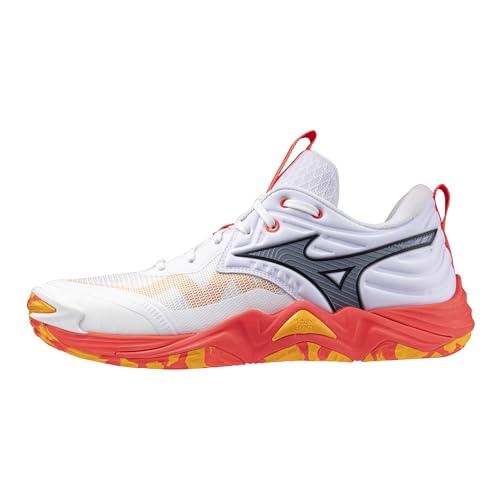 Mizuno Wave Momentum 4 Elite
The premium version of Mizuno’s popular Momentum. An ENERZY CORE forefoot insert and Dyna-Heel Lock add extra cushioning and heel stability for hitters and middles who land hard on every rally.
Best for Power Players
The Mizuno Wave Momentum Elite is the best pick on this list for outside hitters, opposites and middle blockers who jump and land on almost every rally. It’s the premium version of the Wave Momentum 3, with extra cushioning where you push off and extra stability around the heel.
You’ll also see it sold as the “Wave Momentum 4 Elite”, and it’s the same shoe. Mizuno doesn’t use the “4” in its own name, and it isn’t a replacement for the Momentum 3, which sits at number two on this list.
The big difference is a MIZUNO ENERZY CORE insert under the forefoot, sitting on top of the regular MIZUNO ENERZY midsole. That’s the part of your foot that takes the load on every approach and landing, so it’s exactly where a jumper wants more cushioning and energy return.
For stability, a Mizuno Wave plate spreads out the impact of each landing, and Dyna-Heel Lock works with the laces to keep your heel, ankle and shoe lined up as you move. DynamotionFit bootie construction wraps your midfoot, an XG Rubber outsole handles traction, and a Dura Shield toe protects against floor drag.
Owners mostly talk about the comfort and the grip, and a few say it feels lighter than it looks. The one recurring complaint is width. The toe box is narrow, and plenty of owners say it fits tight across the front of the foot.
It comes in unisex sizing (a men’s 7 is a women’s 8.5) plus a women’s version, and there’s a mid-top Wave Momentum Elite Mid if you want more around the ankle.
My list of the best volleyball shoes for hitters compares it with other brands. My best Mizuno volleyball shoes guide shows how it stacks up against the Momentum 3 and Momentum Pro.
The most cushioned Momentum Mizuno makes, as long as your feet aren’t wide.
Recommended Use
I’d recommend the Mizuno Wave Momentum Elite to outside hitters, opposites and middle blockers who jump on almost every rally and want more forefoot cushioning than the Momentum 3, as long as they don’t have wide feet.
The Good
MIZUNO ENERZY CORE forefoot insert for extra cushioning and energy return on take-off.
Dyna-Heel Lock works with the laces to keep your heel locked in.
Mizuno Wave plate spreads out the impact of every landing.
XG Rubber outsole built for traction on indoor courts.
The Bad
Narrow toe box, so it can feel tight on medium and wide feet.
More cushioning than most liberos and setters need.
 ASICS Sky Elite FF 3
This is quite simply the best volleyball shoe we’ve seen hit the market in recent years. They stick to the floor like glue, have a super fluid heel-toe transition, strong support, and excellent shock absorption.
Best for Competitive Players
I’ll be direct: the Sky Elite FF 3 is ASICS’ top-of-the-line volleyball shoe, and owners consistently praise its comfort.
What makes it stand out is how ASICS combined their FLYTEFOAM cushioning with an incredibly secure heel lockdown.
Your heel barely moves inside the shoe – which is exactly what you want. Every time your heel slides around, you lose energy and risk a rolled ankle. That problem doesn’t exist with the Sky Elite FF 3.
The AHAR+ outsole is ASICS’ hard-wearing rubber, built to hold up to hours of pivoting on indoor courts.
It’s no accident that ASICS markets this as their premium competition shoe.
The mid-top collar provides ankle support without restricting movement – something that’s surprisingly hard to get right. You get protection where you need it without the bulkiness that tanks agility.
It also sits at #1 in our best volleyball shoes for flat feet and best ASICS volleyball shoes roundups.
The Good
Best grip on this list for clean courts.
Outstanding heel lockdown
FLYTEFOAM cushioning is plush but still responsive
Mid-top collar gives ankle support without restricting movement.
The Bad
Premium price – most expensive on the list.
If budget matters, the Netburner Ballistic FF 3 gets you close for less
 ASICS Upcourt 6
The Upcourts are Asics’ most affordable court shoes, which explains their popularity. They may not be the toughest shoes on the market, but they deliver solid performance for the price. This shoe isn’t just for volleyball; many players also use it for sports like squash.
Best for Beginners
The ASICS Upcourt 6 is one of the most popular entry-level volleyball shoes around, and the reason is simple: ASICS has nailed the formula for an entry-level court shoe. Light, stable, and well-made, it covers everything a new player needs.
It’s not the toughest shoe ASICS makes, and it’s not the most cushioned either. But for a new player getting into volleyball, it covers every base you actually need.
The lightweight build makes it comfortable to move in all session long, and the grip is solid enough for most indoor courts.
The men’s version has a faux leather exterior for durability and better lateral support. The women’s version uses mesh – sacrifices a little durability but breathes better. Neither is a bad choice.
Over 20 colorways means you can match your team kit without much trouble. For more options at this price point, see our budget volleyball shoes guide.
Recommended Use
A solid all-around shoe for any position. Hitters will eventually want more jump support, but for beginners or recreational players, the Upcourt 6 is hard to beat. Works well for both flat feet and high arches.
The Good
Very lightweight and flexible with 20+ color options.
Great value from a trusted brand
Solid all-around performance at the price.
The Bad
Not ideal for ankle support at a competitive level.
Won’t last as long as higher-end options if you’re playing multiple times a week.
 ASICS Gel-Rocket 12
A dependable indoor court shoe that balances cushioning, stability, and traction, ideal for players who want reliable volleyball performance without premium pricing.
Budget Frontcourt
The Gel-Rocket line has been a reliable budget pick for indoor sports for years, and the Gel-Rocket 12 keeps that tradition going.
ASICS originally developed GEL cushioning for running shoes to handle impact on concrete – bringing it to court shoes was smart, and the shock absorption is noticeably better than most shoes in this price range.
You get FLYTEFOAM cushioning to help you jump higher and land softer, TRUSSTIC technology for stability, and no-sew overlays for a cleaner fit.
The gum rubber outsole gives dependable grip for side-to-side movement and directional changes.
This is a great shoe for a season of regular play. Don’t expect it to last three or four years of hard use – it’s not built for that. But for the price, the all-around performance holds up well.
A dependable budget pick that’s perfect for regular indoor games.
Recommended Use
Perfect for any court position, the shoe moves easily with your foot while providing comfort. Like most Asics shoes, they work well for both flat feet and high arches.
The Good
GEL technology gives better shock absorption than the price suggests.
Flexible and moves naturally with your foot.
TRUSSTIC for improved stability. Reliable ASICS brand.
The Bad
Not ideal for wider feet.
Average durability, this is a seasonal shoe, not a long-term investment.
 Adidas Ligra 8
The Adidas Liga 8 is a well-rounded indoor sneaker that checks nearly every box for a solid volleyball shoe. Its airy mesh and lightweight build keep your feet comfy enough that you’d forget that you’re even wearing them.
Budget Backcourt
The Adidas Ligra 8 misses some features of higher-end Adidas volleyball shoes, but it gets the important things right – especially for backcourt play.
The traction is the standout. That non-marking rubber outsole bites into the court cleanly, and directional changes feel smooth and controlled.
If you’ve been playing in basketball shoes or running shoes, you’ll immediately feel the difference when you plant for a dig or cut hard across the court.
They look fairly bulky, but owners describe them as light on your feet.
The upper combines mesh for airflow with synthetic leather for support, and the Adituff toe protects against wear from lunges and dives – a smart detail for defensive players who spend a lot of time near the floor.
The slightly wider fit makes this a great option for players who struggle to find volleyball shoes that don’t pinch. For more Adidas options, see best Adidas volleyball shoes.
Recommended Use
Best for liberos and other defensive players who prioritize quick footwork. The cushioning isn’t sufficient for high-volume jumpers like middle blockers – step up to the Gel-Rocket 12 or higher for that.
The Good
Mesh and synthetic layer combination for better breathability and durability.
Good traction.
Adituff Toe for better traction during serves, volleys, and fast movements across the court.
The Bad
Insufficient impact protection for mid-blockers.
 LI-NING Wade All City 12
Designed for quick movers like setters, liberos, and outside hitters, these shoes combine a featherlight feel with excellent traction and comfortable cushioning. They’re also the most beautiful pair of shoes on the list.
Best for Agility
Li-Ning isn’t a brand most volleyball players in the US know, but they make quality court shoes and this one is genuinely impressive.
The Wade All City 12 is designed for quick movers – setters, liberos, outside hitters – and it shows in how it’s built.
Li-Ning’s BOOM Lightweight Technology in the midsole gives the shoe extra bounce with cushioning that keeps forefoot pressure low.
The double-layer PROBAR LOC stabilizer, full palm TPU surround, and rubber flip-up in the midsole provide stability without adding bulk. The TUFF RB rubber outsole gives reliable traction across court surfaces.
The upper construction is well thought out – dense woven mesh at the toe, airy midfoot mesh for breathability, and a leather heel with inner boot design for lockdown. Works well for players with wider feet too.
The one drawback is the collar. It’s cut fairly open, so lockdown isn’t as tight as on the ASICS models above. But it’s also the most visually striking shoe on this list, available in two excellent colorways.
Recommended Use
Best for setters and outside hitters who prioritize agility and court feel. Good ankle support for a low-top shoe. Not my first pick for heavy blockers who need serious cushioning on repeated high jumps.
The Good
Offers great comfort and shock absorption without losing its bounce.
A great pick for players with wider feet.
Available in two stunning colorways.
The Bad
The collar feels a bit too open, so the lockdown isn’t quite as snug as you’d want.
Durable.
 RIP-IT Future Court Volleyball Shoes
Players love this pair for its premium ankle protection features, but the comfort it offers should not be underestimated at all.
Best for Ankle Support
The RIP-IT Future Court is a women-only model, which is a shame, because its ankle protection is the most interesting idea on this list.
Ankle protection is the whole point of this shoe.
Three key flex grooves let the shoe move naturally with your foot, reducing both the chance and severity of ankle rolls.
RIP-IT claims the design lessens hard landing impact by 63% and decreases overall landing force by 22%.
I can’t verify those numbers independently, so treat them as RIP-IT’s own claims. What I can say is that the design targets the right problem, because most volleyball ankle sprains happen when landing from a jump.
SwiftStep Technology gives the sole strong responsiveness – sprinting, pivoting, and stopping all feel secure.
FitSync 360° creates a custom fit with a roomy toe box and locked-in heel. RIP-IT recommends sizing up half a size from your usual sports shoes.
If ankle injuries have been an ongoing issue, also check our best volleyball shoes for ankle support guide and best ankle braces for volleyball.
Recommended Use
Best for female outside hitters and middle blockers with a history of ankle issues, or players coming back from an ankle injury. The impact reduction genuinely helps for positions involving frequent high jumps and hard landings.
The Good
Reduced risk of ankle injuries.
Specially designed to fit female foot sizes and shapes.
Makes movements quicker and more effortless on the court.
The Bad
No men’s or unisex version.
Final Verdict?
If I had to pick one shoe from this list, it’s the ASICS Netburner Ballistic FF 3. The most well-rounded volleyball shoe on this list – great traction, solid lockdown, and it works for any position. For most players at most levels, this is the one.
If budget is the priority, go with the ASICS Gel-Rocket 12 for frontcourt or the Adidas Ligra 8 for backcourt/libero. Both punch well above their price point.
For competitive-level play, the Mizuno Wave Momentum 3 and the ASICS Sky Elite FF 3 are exceptional. The Mizuno wins on bounce and weight; the Sky Elite wins on grip and overall comfort.
Every shoe on this list earned its spot. What’s on your feet matters more than most players realise – it affects how you move, how high you jump, and how your joints feel the morning after a long game.
What To Look For In A Volleyball Shoe?
When we consider what factors are most important for us to play our best, athletes will often talk about staying hydrated, being focused, and pure athleticism.
We rarely consider the importance of the equipment we wear, other than whether or not it looks good!
As we discussed above, factors like comfort, shock absorption, and grip are so important for volleyball players to play their best.
What’s more, each volleyball position has slightly different skills, which means every player demands something slightly different from their bodies.
For example, a libero and middle blocker are both playing on the court, but one is often diving and rolling while the other is jumping and shuffling. This means it’s important to consider your position’s demands when choosing your shoe.
I’ll briefly run through the design aspects I looked at to help me decide which of the above volleyball shoes were worth recommending.
Ankle Support
Any sport where jumping and lateral movement is involved requires a fairly hefty amount of ankle support.
Some defensive specialists, particularly ones with exceptional body control, will need less ankle support and can instead opt for a lighter weight, more flexible shoe to increase their court agility.
On the other hand, hitters who are constantly jumping and landing are putting lots of strain on their ankles, especially if they don’t have proper landing mechanics.
Learning to jump and land safely are crucial, but having shoes with ankle support is important protection to have.
Shock Absorption
I believe this is the most important factor to consider for volleyballers who do a lot of jumping (outside hitters, middle blockers, and opposites).
Every time you jump, or land from a jump, your joints take a hit.
If your shoes absorb force poorly, that pressure will slowly wear your knees down until you’re left with a chronic overuse injury like tendonitis.
This is one of the main reasons I often recommend basketball shoes for volleyballers, because they’re designed with these landing forces in mind.
Traction & Grip
The Asics Sky Elite FF shoes are the best of the above so far as traction goes.
If you’re primarily playing on an outdoor court, either of the basketball shoe options on this list are by far the best choice.
However, if the floor you’re playing on doesn’t offer much traction, there’s no shoe in the world that can help.
Always wipe your shoes and keep them clean. It’s important to consider replacing your shoes once you notice the grip on the sole starting to fade.
If you start to slip more often and you can’t figure out why, I’m sorry to say, it might be time to look at getting another pair.
Weight
This factor will often come down to personal preference.
Certainly it’s not ideal to have great big bulky shoes, but nowadays most shoes are fairly similar in terms of weight.
The Mizuno Wave Momentum 3 is easily the lightest shoe on my list and are considerably lighter than most of the others.
Perhaps more important than weight is how mobile, flexible, and agile the shoe allows you to be on court.
The Mizunos offer great support and grip, allowing you to change direction quickly if you need to lunge after a ball. This makes them a great choice for liberos or defensive specialists.
Style
I know I said that earlier we tend to only care about how our shoes look. That doesn’t mean you shouldn’t give it some thought when you’re deciding what pair to get!
If I’m wearing a crisp new pair of shoes with lots of cushioning and bounce, I’m going to feel a lot more powerful and explosive on court than I would if I was wearing an old pair of worn out trainers…
There are plenty of options out there in terms of colors and design. Don’t be afraid to go for something bold, but remember not to choose a nice-looking pair rather than something that actually feels comfortable.
Confidence goes a long way when it comes to playing your best, but it isn’t everything!
Best Place To Buy Volleyball Shoes?
Obviously, being able to try on the shoes you want before you buy them is ideal, so a bricks-and-mortar store would be the best option.
Try searching for a store that has experienced employees who can give you insight on the shoes you’re looking at. Don’t be afraid to ask questions!
Unfortunately, it’s pretty rare to find volleyball shoes in sports stores these days, which is why most people turn to the internet to buy their shoes.
If you buy online, a few quick checks save a lot of hassle:
- Choose a retailer with easy returns, so you can swap sizes if the fit is off.
- Check the brand’s size chart. ASICS, Mizuno, Nike and Adidas all fit slightly differently.
- Read owner feedback on fit. Players will usually tell you if a shoe runs big or small.
- Make sure you’re buying the current model, not an older version with a similar name.
What Are The Best Volleyball Shoe Brands?
While there are plenty of shoe manufacturers out there today, there are really only four of them who specifically design volleyball shoes AND do it well.
These would be Asics, Mizuno, Nike, and Adidas.
Many moons ago, Mizuno and Asics were the top dogs when it came to volleyball shoes. This was mainly because these were the only brands making shoes specifically for volleyball.
Nike and Adidas jumped into the volleyball shoe game not so long ago and have been making some really quality shoes.
Recently, Nike and Adidas have added volleyball shoes to their product line.
This was a natural progression, since 1) they were already making basketball shoes, which have plenty of overlap with what’s needed in a volleyball shoe, and 2) the game of volleyball has grown so much in recent years. Why not try to tap into that market?
While Nike is now marketing shoes as specifically designed for volleyball, Adidas tends to market more to the general court sport (handball/squash/badminton) market.
What Are The Most Popular Volleyball Shoes?
Not too long ago, if you were to look around most volleyball courts, you’d probably see a lot of Mizunos and Asics being worn.
These two brands have been the most popular for a long time now. However, Nike and Adidas are becoming more and more popular as their shoes become better suited for volleyball.
Nike has been gaining ground too. The Nike Zoom Hyperset 2 was featured heavily at the Paris 2024 Olympics, and it’s the shoe Nike now builds its volleyball line around.
The next time you’re watching a pro or international volleyball match, see if you can tell how many players are wearing a specific brand. You can use that as a starting point when you’re looking for your next shoe!
What Are The Most Comfortable Volleyball Shoes?
For comfort, my pick is the ASICS Sky Elite FF 3, and owners consistently praise how comfortable it is.
This is thanks to how well the shoe keeps your ankle locked into the heel of the shoe. Having your foot slide around inside your shoe during a game is uncomfortable, and can even risk injury.
Ultimately, how comfortable a shoe is comes down to your personal foot shape and preference.
Do you have flat feet or high arches? or have wide feet?
Every shoe is going to fit slightly differently, and it’s important to make sure that the shoe you choose is the right fit for you!
How Should Volleyball Shoes Fit?
Volleyball shoes should fit snug around your foot, without letting your heel slide around as you’re taking steps.
They shouldn’t be too tight around the sides of your feet, which can cause discomfort after long games.
I’ve included information about which shoes fit well for people with wide feet in the above write-ups.
But if your heart’s set on the look of a certain shoe that isn’t ideal for wide feet, I’d suggest buying half a size higher than normal.
In a perfect world, we’d be able to try before we buy, but that’s simply not an option for a few of these shoes.
Volleyball Shoe FAQ
Below I’ve taken the time to answer a few of your most commonly asked volleyball shoe questions.
What are the best volleyball shoes for beginners?
The ASICS Upcourt 6 is the best starting point. It’s light, comes in 20+ color options, and covers everything a beginner needs. If you want more cushioning, the ASICS Gel-Rocket 12 is the step up.
Can I use basketball shoes for volleyball?
Yes – basketball shoes are actually a solid choice because they’re designed with jumping and landing in mind. The Nike Zoom Hyperset 2 on this list bridges both sports well.
What are the best volleyball shoes for women?
The ASICS Netburner Ballistic FF 3, Mizuno Wave Momentum 3, and ASICS Sky Elite FF 3 Mid all have excellent women’s versions.
What about Under Armour volleyball shoes?
Under Armour has a limited volleyball-specific range, but some of their court options are worth considering.
Which volleyball shoe is right for my level?
Beginners and casual players are well covered by the ASICS Upcourt 6, ASICS Gel-Rocket 12 or Adidas Ligra 8. If you train several times a week, look at the Nike Zoom Hyperset 2. Competitive players get the most from the ASICS Sky Elite FF 3 or the Mizuno Wave Stealth Neo 2.
How should volleyball shoes fit?
Snug around the foot without heel slide, but not so tight your toes are cramped. If you’re between sizes, go half a size up. What makes volleyball shoes different from regular court shoes is worth reading if you’re buying your first pair.
Our Top Recommendation

ASICS Netburner Ballistic FF 4
A great choice for all level players. The Netburner Ballistic FF 4 has great traction and balance, all while providing ankle stability and I have to say that the design isn’t half-bad either.
If you make a purchase, we may earn a commission at no extra cost to you.
VOLLEYBALLVAULT.COM

