
Whether you’re brand new to volleyball or you’ve been playing for years, a decent pair of knee pads is fairly essential kit.
And if you’re anything like me, you’ve probably also bought a pair that looked great online, then spent an entire season regretting it.
There’s a ridiculously large range of volleyball knee pads on the market, some of which are excellent, and others that are really quite awful…
Our 6 Top Picks:

BEST OVERALL
Mizuno LR6
MIZUNO
BEST FOR LIBEROS AND DIGGERS
Mizuno T10 Plus
MIZUNO

BEST FOR WOMEN
Under Armour Strive 3
UNDER ARMOUR

BEST FOR YOUTH & GIRL
Mizuno T10 Plus
MIZUNO

BEST FOR MEN
Nike Varsity
NIKE
BEST BUDGET
Adidas
ADIDAS
Click here to learn more about our volleyball knee pad testing and review process.
The tricky part is that this market has shifted a lot in the last couple of years. Some of the pads that every guide on the internet still recommends aren’t even manufactured anymore.

So we went and bought the current lineup and tested them properly. Here are the 6 pairs actually worth your money in 2026, including our picks for women, men, youth players and liberos.
Let’s begin!
 Mizuno LR6 Volleyball Kneepad
 The pad you'll see on more knees than any other, and for good reason. Mizuno's low-rise LR6 keeps VS-1 padding over the high-impact zone without the bulk that makes most pads bunch up behind your knee by the third set.
Best Overall: Mizuno LR6 Volleyball Kneepad
Walk into any gym in the country and look down at people’s knees. You’ll see these more than anything else.
That’s not an accident.
The LR6 is Mizuno’s low-rise pad, which means a 6.75-inch sleeve that sits close to the joint and doesn’t gather up behind it when you bend. Mizuno calls the construction Dynamotion Fit. What that means in practice is the pad flexes with your leg instead of rolling itself into a sausage behind your knee by the third set.
The padding is Mizuno’s VS-1 foam, concentrated over the high-impact zone with coverage running down both sides of the knee as well. So you’re covered on a straight drop and on those awkward sideways landings too.

What really sells me on it, though, is how consistently players pick it for themselves. Ask on any volleyball forum which pads to buy and you’ll get a wall of people saying Mizuno. One player described them as “my ride or die.” That kind of thing is hard to manufacture.
It’s also just easy to buy, which matters more than people think. Every specialty retailer stocks it at full price, in four colourways.
Be honest with yourself about the padding though. This is a thin pad. If you’re a libero who spends more of the match on the floor than on your feet, skip ahead to the T10 Plus instead.
And if you want the same shape with more cushioning underneath, Mizuno now makes the LR6 Pro, which adds tri-density foam for a bit more money. Same sizing, same low-rise cut, softer landing.
Recommended Use
I’d recommend the LR6 to outside hitters, middles and setters who want genuine protection without a brick strapped to each leg.
The Good
VS-1 padding sits over the high-impact zone with lateral and medial coverage, not just a pad across the kneecap.
The 6.75-inch low-rise sleeve is specifically built not to fold behind the knee.
Dynamotion Fit construction lets the pad move with the joint instead of fighting it.
It’s the most recommended volleyball knee pad among actual players, and it shows up in 12 of the 15 buying guides we looked at.
Stocked at full price nearly everywhere, in white, black, navy and white-pink.
The Bad
It runs small. One reviewer put it bluntly: small fits a child, medium fits a teen, large fits an adult. Worth reading up on how your knee pads should actually fit before you order.
The padding is genuinely thin. More than one player has reported bruising on a hard dive in a fresh pair.
Sizes stop at large, which works out to roughly a 16-inch knee. There’s no XL.
 Mizuno T10 Plus Adult Kneepad
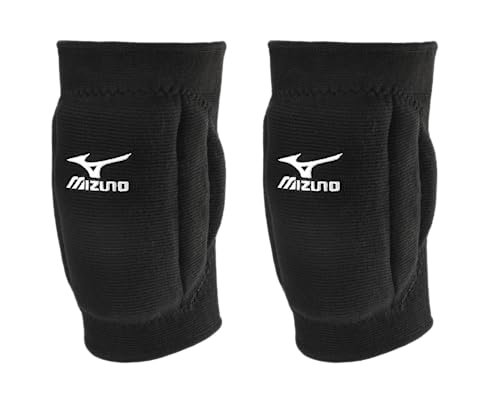
 The longest pad Mizuno makes, and the one you'll see on half the liberos at any club tournament. Nine inches of coverage with five separate padded sections, so it protects the part of your leg that actually hits the floor when you slide.
Best For Liberos And Diggers: Mizuno T10 Plus Adult Volleyball Kneepad
If you play libero, this is the pad I’d point you at first.
The reason is length. The T10 Plus runs 9 inches with wrap panels down the sides, making it the longest pad Mizuno builds and the longest on this list by a fair margin. The LR6 above covers your knee. This one covers your knee, the top of your shin, and a chunk of thigh above it.
That matters more than people realise, because liberos don’t really land on their knees. They slide.
And when you slide, the bit of your leg that meets the floor is usually just below the kneecap, not on it. A short pad leaves that exposed. A 9-inch one doesn’t.
The padding is split into five separate contoured sections rather than one solid block, so the sleeve still bends properly instead of fighting your leg every time you drop into a dig.
It’s also the most proven pad here, if I’m being completely honest. It’s been in Mizuno’s line for years, it sits at 4.7 stars across close to 8,000 Amazon ratings, and it’s the plain black and white Mizuno that just about everybody ends up owning at some point.
If you’re kitting yourself out for the position properly, it’s worth looking at shoes built for liberos as well. Different piece of gear, same thinking behind it.
Recommended Use
I’d recommend the T10 Plus to liberos, defensive specialists, and anyone who ends up on the floor more than a couple of times a set.
The Good
A 9-inch sleeve with wrap panels, the longest coverage of any pad on this list.
Five separate contoured padding sections, so the sleeve flexes instead of bunching behind the knee.
Close to 8,000 Amazon ratings at 4.7 stars, comfortably the deepest track record of anything here.
The one-size fit conforms to the knee, and several players say it beat the sized pads they’d returned.
Sold in black and white, and stocked at basically every volleyball retailer going.
The Bad
One size only for adults. If your knee sits outside the range this is built for, there’s no alternative within this model.
Length isn’t the same thing as cushioning. This is a slim pad. It covers more of you, but it won’t soften a hard landing the way a thick bubble pad does.
More fabric on your leg means more heat. In a warm gym, you’ll notice it.
 Under Armour Strive 3 Volleyball Knee Pads
 The pad that actually stays where you put it. An interior silicone band grips your leg instead of relying on compression alone, which fixes the single most common complaint players have about knee pads sliding down mid-match.
Best For Women: Under Armour Strive 3 Volleyball Knee Pads
Let me be straight with you about something first.
Nobody makes a women’s-specific volleyball knee pad. Not Mizuno, not Nike, not adidas. Every pad on this list is unisex, including this one, and any article telling you otherwise is guessing.
So when I say this is the best pick for women, I mean it solves the fit problem women actually run into. Which is pads that won’t stay put.
Ask around and you’ll hear the same thing over and over. They slide down after a dive. They roll up behind the knee. You spend half the match hitching them back into place. It comes up constantly from players with slimmer legs, and it’s easily the most common knee pad complaint I’ve come across.
The Strive 3 has an interior silicone retention band running around the inside of the sleeve. That’s the fix. It grips your leg rather than relying on compression alone to hold position.
The padding is licensed McDavid HEX, 8mm and dual density, which is a genuinely good bit of engineering to find on a pad at this price. It’s low profile too, so it sits close and doesn’t feel clunky. That’s the other thing that puts a lot of players off thicker pads.
Sizing goes by measured knee circumference rather than guesswork, which I wish more brands did. Measure the widest part of your knee with your leg bent just under 45 degrees and match it to their chart. Small covers roughly 13 to 14.5 inches, medium 14.5 to 15.5, and large 15.5 to 16.5.
One last thing worth knowing before you blame the pad. A lot of slipping gets solved by wearing them lower on the leg than feels natural, not by buying something different.
Recommended Use
I’d recommend the Strive 3 to any player, women especially, whose knee pads refuse to stay where they’re put.
The Good
An interior silicone retention band, which is the actual engineering answer to pads sliding down.
8mm dual-density McDavid HEX padding, licensed tech rather than generic foam.
Genuinely low profile, so it doesn’t feel bulky or get in the way of how you move.
Sized by measured knee circumference against a published chart, not vague S/M/L guessing.
HeatGear lining, plus a high-abrasion cover over the pad itself.
The Bad
Sizes stop at large, roughly a 16.5-inch knee. There’s no XL in this model.
The review base is thin next to the Mizunos on this list. It’s a newer pad and hasn’t built up years of feedback yet.
Low profile means less cushioning. If you dive hard and often, the T10 Plus above will look after you better.
Mizuno Youth T10 Plus Volleyball Kneepad A proper youth pad with its own sizing, not an adult small in disguise. Long wrap coverage protects below the kneecap, which is exactly where younger players hit the floor when a dig turns into a slide.
Best For Youth And Girls: Mizuno Youth T10 Plus Volleyball Kneepad
If you’re buying for a kid, buy a pad actually built for kids.
That sounds obvious. Most parents don’t do it.
Here’s what happens instead. You look at what the older girls on the team are wearing, notice it comes in a small, and buy a small. Then you find out that “small” in adult sizing is cut for a teenager, not a nine-year-old, and your daughter spends the season with a pad that either strangles her calf or slides down around her ankle.
Mizuno makes a proper youth version of the T10 Plus. It’s a separate product with its own sizing, not just an adult pad shrunk in the wash.
It keeps everything that makes the adult one good. Long wrap-around coverage, contoured padding sections that let the sleeve actually bend, and the same slim profile that doesn’t feel like strapping cushions to your legs.
The length is the part parents underestimate. Younger players land messily and slide further than they mean to, so coverage below the kneecap earns its keep. One parent mentioned the longer pad stopped the backs of her daughter’s knees getting rubbed raw the way shorter pads had.
Coaches keep recommending these, which counts for something. One wrote that he’d worn them himself as a player and now recommends them to everyone he coaches.
Two practical things before you buy. Fit means stays up without being tight, so if it’s leaving marks it’s too small, and if she’s yanking it up between rallies it’s too big. And expect to replace them, because kids destroy knee pads. One grandmother reported going through a pair in a single month.
If you’re kitting out a new player from scratch, our guide on what to wear for volleyball tryouts covers the rest of the kit.
Worth knowing: if your player is at the smaller end of the range, BraceUp makes a youth pad sized by height rather than age, which is a far easier thing for a parent to measure. Their XS covers roughly 3’7″ to 4’3″, and small runs to about 4’11”.
Recommended Use
I’d recommend the Youth T10 Plus to club and school players roughly 8 to 14, especially the ones who slide around more than they’d care to admit.
The Good
A genuine youth product with its own sizing, not an adult pad scaled down.
Long wrap coverage protects below the kneecap, which is where younger players actually meet the floor.
Contoured padding sections keep the sleeve flexible rather than stiff.
Same Mizuno build quality that club parents and coaches already trust.
Slim enough that kids will actually keep them on.
The Bad
One size only, so there’s nothing to adjust as your player grows.
Colour choice is limited, and black sells out more often than white.
It’s a slim pad, not a thick bubble one. If your player wants maximum cushioning, this isn’t it.
 Nike Varsity Volleyball Knee Pads
 The widest size range of any major volleyball brand, running XS/S all the way to XL/XXL. It's also the thickest pad Nike makes, with foam that wraps the sides of the knee instead of sitting flat across the front.
Best For Men: Nike Varsity Volleyball Knee Pads
Same disclaimer as the women’s pick. There’s no such thing as a men’s volleyball knee pad. Every pad on this list is unisex.
What there is, though, is a size ceiling. And Nike’s is the highest of the major brands.
Mizuno stops at large. Adidas stops at large. Under Armour stops at large. Nike runs XS/S, M/L and XL/XXL, which takes it up to roughly an 18-inch thigh. If you’re a bigger guy who has ever pulled a “large” halfway up your calf and quietly given up, that difference is the entire reason this pad is on the list.
The Varsity is also the thickest pad Nike currently makes, and the padding wraps around the sides of the knee rather than sitting flat across the front. Land awkwardly on the outside of your knee, which happens more than you’d like when you’re chasing a ball out towards the antenna, and there’s actually foam there.
The sleeve is open-knit for airflow, which is a fair trade for the extra bulk. Nike being Nike, there’s Dri-FIT in the lining too.
One warning that turns up in review after review: these run small. Order a size above whatever you’d normally take. That advice is consistent enough that Nike’s own product page reviews lead with it.
And if the price makes you wince, the Nike Streak is the cheaper option from the same family. Less padding, and it tops out at XL rather than XL/XXL, but plenty of high school players swear by it and it’s the Nike pad you’ll see most often on court.
Recommended Use
I’d recommend the Varsity to men and bigger players generally, and to anyone who wants proper side-of-knee coverage rather than a flat pad across the front.
The Good
The widest size range of any major brand here, running XS/S through XL/XXL.
Padding wraps around the sides of the knee, not just across the front of it.
Nike’s thickest current volleyball pad, making it the most protective of the mainstream options.
Open-knit sleeve for airflow, which offsets the extra padding in a hot gym.
Part of Nike’s actual volleyball line rather than a generic multi-sport pad.
The Bad
It runs small. Size up, and treat that as an instruction rather than a suggestion.
Even XL/XXL only reaches around an 18-inch thigh, so genuinely large-legged players will still struggle. There’s more on that further down.
It’s the priciest pad on this list.
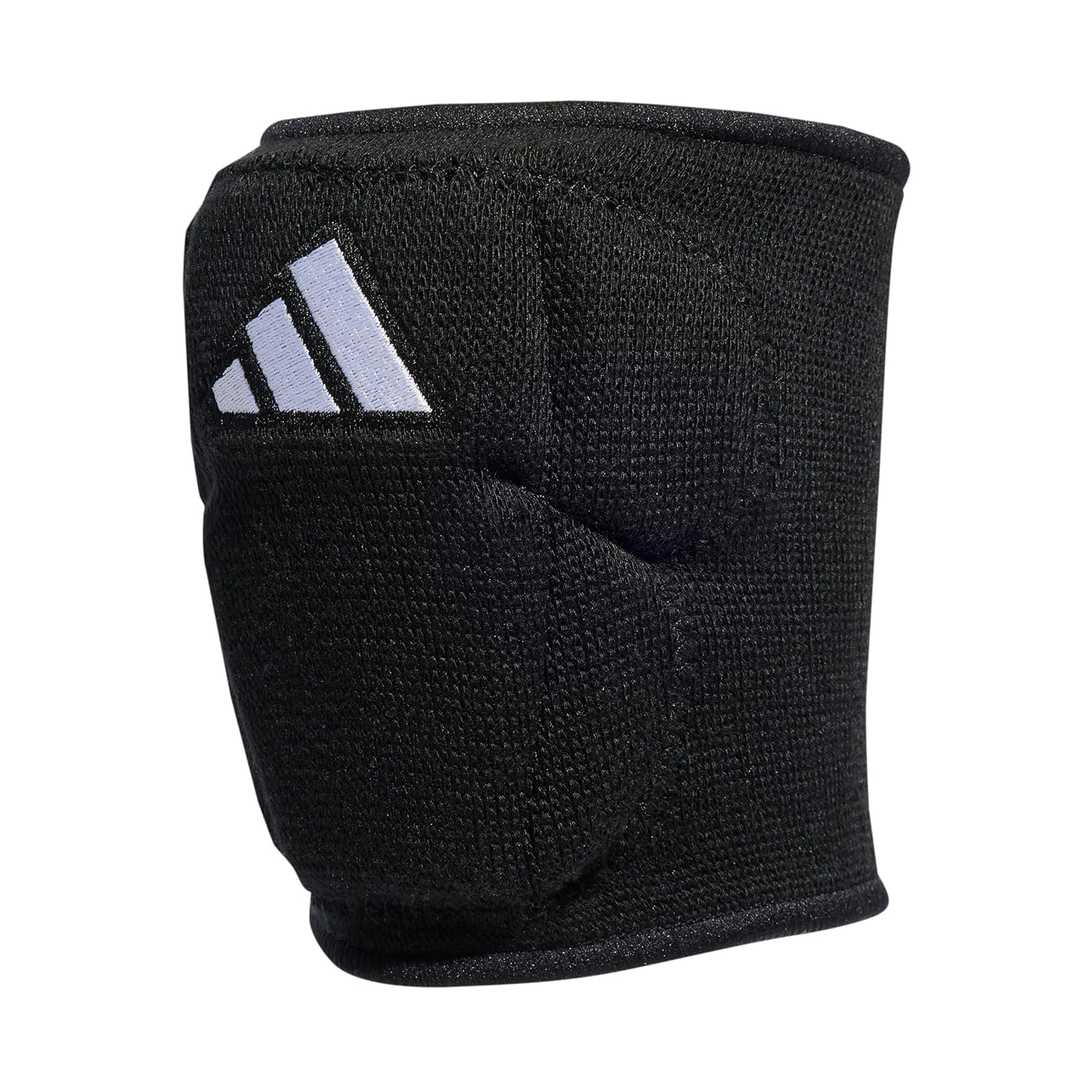
 Adidas Volleyball Kneepads
 The cheapest pad here and the one that vanishes under spandex. Five inches of shock-absorbing EVA over the kneecap, and unlike almost everything else in this category, you can throw them in the washing machine.
Best Budget And Lowest Profile: Adidas 5-Inch Volleyball Kneepads
This is the cheapest pad on the list, and for a lot of players it’s also the most sensible one.
Five inches. That’s the entire sleeve. It covers your kneecap and stops. Sitting next to the 9-inch T10 Plus it looks almost apologetic.
But here’s the bit most buying guides get backwards.
Knee pads aren’t crash protection. Ask experienced players what their pads are actually for and you’ll get a version of the same answer every time: they stop you skidding across the floor and taking the skin off your knees. Once your technique settles, the impact gets absorbed by your chest and forearms, not your knees.
One player summed it up better than I could. Thin ones work just as well, they’re less bulky, and they’re less hot and sweaty.
So if you’re an outside hitter, a middle or a setter who spends most of the match upright, five inches of EVA over the kneecap is genuinely all you need. It disappears under spandex. You forget it’s there.
The other thing I like about these is that they’re machine washable. Nike’s pads say hand wash only. If you’re playing three or four sessions a week and you’d rather your kit bag didn’t develop its own personality, that’s not a small detail.
They’re built mostly from recycled polyester too, if that matters to you, and there’s a proper kids version alongside the adult one.
If you want the same brand with more coverage, the Adidas Elite steps up to a 7.5-inch sleeve with anatomical flex zones. Reviews are strong overall, though a decent chunk of buyers reckon the padding is thinner than the product photos suggest. Go in with your eyes open.
Recommended Use
I’d recommend the 5-Inch to hitters, middles and setters who spend most of the match on their feet, and to anyone who finds bigger pads restrictive.
The Good
The cheapest pad on this list by a clear margin.
A 12.75cm sleeve, the lowest profile here and genuinely invisible under spandex.
Machine washable, which almost nothing else in this category is.
Made largely from recycled materials, and there’s a matching kids version.
The Bad
Five inches is minimal coverage. If you dive and slide regularly, this isn’t enough pad.
Adidas publishes no thigh measurement chart, so choosing between S, M and L is more guesswork than it should be.
Sizes stop at large. No XL here either.
Final Verdict?
If you only take one thing away, make it this: buy two different pairs.
Most volleyball players need more than one pair anyway, and trying two styles side by side tells you more in a fortnight than any article can. Grab the Mizuno LR6 Volleyball Kneepad and the Mizuno T10 Plus Volleyball Kneepad together and you’ll learn very quickly whether you’re a short-pad player or a long-pad player.
If you already know you’re a back-row player who lives on the floor, skip the experiment and go straight to the T10 Plus.
If you’re front row and you want the least pad you can get away with, the Adidas 5-Inch Volleyball Kneepads are the cheapest way to find out.
If your pads never stay up, the Under Armour Strive 3 Volleyball Knee Pads are the ones with the silicone band that actually fixes it.
And if you’re buying for a junior player, get them the Mizuno Youth T10 Plus Volleyball Kneepad rather than an adult small. It’s a different product for a reason.
Mizuno LR6 vs T10 Plus: Which Should You Get?
Get the LR6 if you play in the front row. Get the T10 Plus if you spend real time in the back row.
That’s the short version, and for most people it’s the whole answer. It’s worth understanding why though, because these two get compared constantly and almost nobody explains the difference properly.
| Mizuno LR6 | Mizuno T10 Plus | |
|---|---|---|
| Sleeve length | 6.75 inches | 9 inches with wrap panels |
| Sizing | Small, medium, large, and it runs small | One size for adults, separate youth version |
| Padding | VS-1 foam over the high-impact zone | Five separate contoured sections |
| Feel on the leg | Short, close, barely there | Full coverage, still slim |
| Best for | Outside hitters, middles, setters | Liberos and defensive specialists |
Our Volleyball Knee Pads Testing & Review Process
Between myself and our head product tester Caity, we’ve amassed well over 20 years of volleyball experience. That’s 20+ years of experience wearing different volleyball knee pads!
Although we both tend to wear the Mizuno LR6 knee pads, we decided to purchase 6 of the top rated volleyball knee pads to personally test them out to get a better understanding of which knee pads work the best.
We’re evaluating each knee pad over the course of 30+ contact hours each, based on the following criteria:
- Size/fit/comfort
- Price
- Durability
- Style
Note: We’re continuing our testing process for all knee pads available on the market. We’ll update this article in continuing if we find out better than them.
At that point, we’ll be able to update this article with far more detailed information about each of these volleyball knee pads to help you make an even better purchase decision.
Feel free to read more about our product testing standards and review process.
What We Look For In Volleyball Knee Pads
Pick By Your Position First
Your position on the court should decide your pad before anything else does.
Front row players are upright most of the match. You need protection for the occasional dive, not constant floor contact, so a shorter low-profile pad gives you more freedom without costing you much.
Back row players are the opposite. Liberos and defensive specialists spend real time on the floor, and they need length below the kneecap because sliding takes skin off the shin, not the knee.
Setters sit in between. You’re moving constantly and going to the floor less than a libero but more than a middle, so most setters end up happiest in a low-profile pad.
If you’re not sure where you fit, our breakdown of every position on the court will sort that out first.
What Knee Pads Are My Teammates Wearing?
For many younger players, this is one of the most important factors to consider.
If you’re a parent shopping for knee pads for your child, ask them which knee pads the other kids on their team like to wear and start there.
Of course not all volleyballers care about the social conformity side of things, but it’s definitely something to think about.
Low Profile Pads Are Still Winning
The trend towards thinner, shorter, smaller pads hasn’t reversed.
The reason is that experienced players don’t use their pads the way beginners assume. Once your technique settles, you absorb a dive with your chest and forearms. The pad is there to stop you skidding and burning skin off, not to cushion a crash landing.
One player summed the whole argument up neatly: thin ones work just as well, they’re less bulky, and they’re less hot and sweaty.
The biggest complaint I see about knee pads is that they’re too big or too long, which makes them shift around every time you bend your knee.
That said, there is a real dissenting view and it deserves airtime. Some players who moved from thick pads to thin ones regret it, and say their knees paid for it. If you play on an unforgiving floor or you’ve had knee trouble, the trend isn’t an instruction.
Durability Varies More By Player Than By Brand
Almost every pad on this list will last about as long as any other.
How long that actually is depends entirely on what kind of player you are and how often you hit the ground. The same pair that gets holes burnt through it in a month might last a different player three or four seasons.
Players describe it well: knee pads are like brake pads. They’re designed to wear down. Replacing them isn’t a sign you bought badly.
Minimalist, Low Profile Knee Pads Are Trending
In today’s game, all the rage is ultra low profile knee pads. The thinner, shorter, and smaller, the better.
One of the biggest complaints I see about knee pads is that they’re too big or too long, which actually reduces comfort as it causes them to shift around on your legs every time you flex your knees.
Low profile knee pads like the Nike Essentials or Mizuno LR6s tend to do a better job of staying in place, because they sit below the knee cap and are easier to walk around in.
Check out this article for more information on how to wear volleyball knee pads properly.
Volleyball Knee Pad Sizes By Brand
There is no standard sizing across volleyball knee pads, and the brands don’t even measure the same part of your leg.
That’s the bit that catches people out. A Mizuno “large” and a Nike “large” are not describing the same measurement, so converting between them by size name will fail.
| Brand | Sizes | What they measure | Ranges |
|---|---|---|---|
| Mizuno LR6 Pro | S, M, L | Knee circumference | S under 13.5″, M 13.5 to 15.5″, L over 15.5″ |
| Mizuno T10 Plus | One size adult, separate youth | n/a | Conforms to the knee |
| Nike (all models) | XS/S, M/L, XL/XXL | Thigh, above the knee | XS/S 14 to 15.5″, M/L 15.5 to 17″, XL/XXL 17 to 18″ |
| Under Armour Strive 3 | SM, MD, L | Widest part of knee, over the kneecap, leg bent just under 45° | SM 13 to 14.5″, MD 14.5 to 15.5″, L 15.5 to 16.5″ |
| Adidas | S, M, L | – | – |
Two things worth knowing before you order.
Mizuno’s LR6 runs small. One reviewer put it as bluntly as anyone could: small is built for a child, medium for a teen, large for an adult. Nike runs small too, and their own product reviews say to size up.
And if you want the full explanation of what a correct fit actually feels like on the leg, we’ve covered how your knee pads should fit separately.
Volleyball Knee Pads For Big Legs
Here’s the answer nobody wants to give you: no major volleyball brand makes a knee pad above roughly an 18-inch thigh.
Mizuno stops at large. Adidas stops at large. Under Armour stops at large. ASICS, Wilson, Champro and Mikasa all stop at large. Nike is the only one of the big brands that goes to XL/XXL, and even that tops out around 18 inches measured above the knee.
So if you’ve spent an evening searching for XXL volleyball knee pads and come up with nothing, you weren’t searching wrong. The products mostly don’t exist.
What to do about it depends on the numbers, so measure first.
If you’re up to about an 18-inch thigh, the Nike Varsity in XL/XXL is your pad. Size up, because they run small.
If you’re between a large and an XL, don’t write off a standard large too quickly. One player at 6’6″ and 260lb wears the Adidas Elite in a large and says they were snug for a couple of games and then loosened up and fit fine. These sleeves stretch with use, so first-wear tightness isn’t always the final answer.
If you’re genuinely above 19 inches, you’re into padded compression sleeves rather than volleyball pads. Bucwild makes one that goes to a 21 to 24-inch thigh in XL, and HUEGLO makes a plus-size pad reaching a 20 to 23-inch thigh in XXL. Neither is a purpose-built volleyball pad and both are thinner than what a libero would want, but they’ll cover you and they’ll stop floor burn.
One more option people forget: check the men’s range even if you’d normally buy women’s. It’s the same product, and the sizes go higher.
What Knee Pads Do Professional Volleyball Players Wear?
Professional players almost universally wear thin, low-profile pads, and they wear them low on the leg rather than over the kneecap.
Watch any international match and you’ll see it. Nobody at that level is wearing the big bubble pads. The pads sit below the knee, they’re barely visible, and plenty of front-row players wear nothing at all.
That tells you something useful. At the top level, technique means players rarely land knee-first, so the pad’s job shrinks to preventing floor burn when they slide. Less pad does that job perfectly well and gets in the way less.
Mizuno is far and away the most visible brand in the pro game, which is a big part of why it dominates recommendations further down the pyramid too. In Europe you’ll also see a lot of Errea, particularly the Tokyo model, which is common in the Italian league but much harder to buy in the US.
The honest takeaway for a club player is this. Copying what pros wear only works if you dive like a pro. If you’re still landing on your knees rather than sliding on your chest, you need more pad than they do, not less.
What Volleyball Players Actually Say About Knee Pads
Spend an hour reading volleyball forums and the same handful of points come up over and over.
Wear them lower than feels natural. This is easily the most repeated piece of advice, and almost nobody follows it at first. Knee pads aren’t really for your knees. The part of your leg that meets the floor when you slide is just below the kneecap, so that’s where the padding should sit.
Mizuno dominates the conversation. Ask which pads to buy and you’ll get a wall of the same answer. One player called them their ride or die. That consensus is why two of them are on this list.
If they fold or ride up, they’re probably too big. Good diagnostic from a player who’d clearly answered it a hundred times: folding usually means you’re sliding on them or they’re oversized, and riding up usually means you’re not wearing them low enough.
Avoid the cheap honeycomb pads from marketplace sellers. This is the strongest negative consensus in the whole category. Multiple players report the outer fabric tearing within one or two sessions and the padding breaking apart straight after.
Watch out for fake Mizunos. Counterfeits turn up regularly on cheap marketplace listings, close enough to fool a photo but not the person wearing them.
They will smell. Air them out after every session and wash them occasionally on a gentle cycle. Every experienced player has an opinion on this and none of them involve ignoring it.
Replace them when the fabric tears and padding starts coming out, not on a schedule. Until then, wear them.
How To Wear And Care For Your Knee Pads
Wear your knee pads low, so the padding covers the area just below your kneecap rather than sitting on top of it. That single adjustment fixes most complaints about pads sliding, folding or feeling wrong.
For the full breakdown, including where the pad should sit for different positions, read our guide on how to wear volleyball knee pads properly.
Washing them is simpler than people assume. Air them out after every session rather than leaving them balled up in your kit bag, and run them through the machine on a gentle cycle when they start to turn. Cold water, no fabric softener, and let them air dry rather than putting them in the dryer, which cooks the elastic.
The Adidas 5-Inch pads are explicitly machine washable. Most others tolerate a gentle cycle fine, but check the label first.
There’s more on materials, breathability and washing them properly in our full knee pad guide.
Best Youth Volleyball Knee Pads?
The best youth volleyball knee pad is the Mizuno Youth T10 Plus, because it’s a genuine youth product with its own sizing rather than an adult pad in a smaller box.
This is where the old advice has aged badly. It used to be true that you could just buy an adult small for a kid. That falls apart the moment you look at the numbers, because an adult small in the Mizuno LR6 line is cut for a teenager, not a nine-year-old.
For younger players specifically, longer coverage helps more than it does for adults. Kids land messily and slide further than they mean to.
If your player is at the smaller end, BraceUp sizes their youth pad by height rather than age, which is a much easier thing for a parent to get right.
Best Men’s Volleyball Knee Pads?
The best men’s volleyball knee pad is the Nike Varsity, and the reason is sizing rather than anything to do with the pad being built for men.
No brand makes a men’s-specific volleyball knee pad. They’re all unisex. What differs is how far the sizes go, and Nike is the only major brand offering XL/XXL while everyone else stops at large.
You’re right that men tend to gravitate towards longer pads. Whether that’s genuine preference or just that male players never bought into the low-profile trend as hard as women did, I couldn’t tell you.
Plenty of men’s players skip knee pads entirely, and at a high enough level with clean technique that’s a defensible choice. For everyone else, try a couple of styles and let your own knees decide.
Volleyball Knee Pad FAQ
What is the best brand of volleyball knee pads?
Mizuno is the best brand of volleyball knee pads, and it isn’t especially close. Ask experienced players which pads to buy and Mizuno comes up more than every other brand combined. Nike, Adidas and Under Armour all make good pads, but Mizuno’s LR6 and T10 Plus are the two most widely worn models in the sport.
How much do volleyball knee pads cost?
Most volleyball knee pads cost between $20 and $40 a pair. Budget options like the Adidas 5-Inch sit at the lower end, mainstream Mizunos land in the middle, and premium pads like the Nike Varsity reach the top of that range. Price varies a little by size and colour.
Where can you buy volleyball knee pads?
You can buy volleyball knee pads on Amazon, at Dick’s Sporting Goods, and directly from Mizuno, Nike, Adidas and Under Armour. Volleyball specialty retailers like All Volleyball and Midwest Volleyball Warehouse usually carry the widest selection and are worth checking if you want a specific colour or size that the big stores have sold out of.
What happened to ASICS volleyball knee pads?
ASICS has effectively withdrawn from the US volleyball knee pad market. The adult Ace Low Profile, which was their best-known pad and which we recommended in earlier versions of this article, no longer appears in ASICS’ own volleyball accessories range, and specialty retailers have moved remaining stock to closeout pricing. You can still find pairs, but you’re buying old inventory rather than a current product. That’s why it’s no longer on this list.
How often should you replace volleyball knee pads?
Replace volleyball knee pads when the outer fabric tears and padding starts coming out, not on a fixed schedule. Some players get three or four seasons out of a pair, while a libero on a rough floor might burn through them in a month. Knee pads are designed to wear down, so replacing them often isn’t a sign you bought the wrong ones.
Do volleyball knee pads run small?
Yes, most volleyball knee pads run small, particularly Mizuno and Nike. Nike’s own product reviews recommend sizing up, and the Mizuno LR6 in particular runs small enough that a small suits a child rather than a small adult. Measure your leg and check the brand’s chart rather than assuming your usual size will carry across.
Are thick or thin volleyball knee pads better?
Thin, low-profile knee pads are better for most players, because a pad’s main job is preventing floor burn when you slide rather than cushioning an impact. Thicker pads still make sense if you play on a hard floor, you’ve had knee problems, or you’re a beginner still landing knee-first rather than sliding on your chest.
Can you wear basketball knee pads for volleyball?
You can, but you probably shouldn’t. Basketball pads and compression sleeves aren’t designed for repeated sliding contact, and players report the outer fabric tearing quickly once you start diving on them. A knee brace is a different product again and offers support rather than impact protection.
How do you stop volleyball knee pads from smelling?
Air your knee pads out after every session instead of leaving them balled up in your bag, and wash them on a gentle cold cycle when they start to turn. Skip the fabric softener and let them air dry, since a hot dryer degrades the elastic. Rotating two pairs also helps, and it extends the life of both.
