
A great block is the loudest moment in volleyball. One second the hitter is winding up for a kill, the next the ball is slammed straight back onto their own floor. The crowd erupts, the hitter freezes, and your whole bench is on its feet.
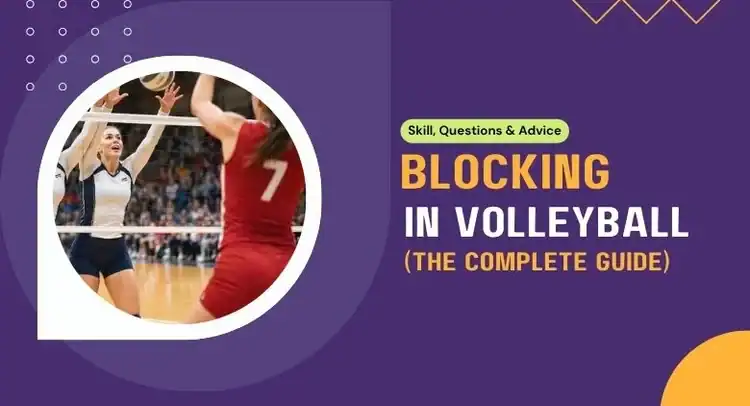
A block in volleyball is a defensive move where one or more front-row players jump at the net, reach over it, and stop or deflect the opposing team’s attack back into their court.
A clean block does more than win a single point. It frustrates the other team’s best hitter, swings the momentum, and buys your back-row defenders precious time to react. In this guide we will walk through the rules, the different types of blocks, the step-by-step technique, and a few drills to pull it all together.
What Is a Block in Volleyball?
When the other team attacks, the ball comes over the net fast and heading down. A block is your first and best chance to stop it right at the source, before it ever reaches your defenders. Front-row players jump with their hands held high above the net to turn that attack away.
A block that sends the ball straight back down onto the attacker’s court is called a stuff block, or a roof. But not every block ends the rally outright. Sometimes you only slow the ball down or change its direction, and that still counts. It gives your teammates a softer, easier ball to dig and keep alive.
That is why coaches call blocking the first line of defense. Simply put, a good block either wins the point on its own or makes the next contact far easier for your team.
Volleyball Blocking Rules (Explained Simply)
Blocking has a few rules that trip up new players, and getting them wrong gives away easy points. Here are the ones that actually matter, each answered straight.
Who Is Allowed to Block?
Only front-row players can block. That means the three players lined up near the net at the start of the rally.
Back-row players are not allowed to block, and the libero can never block or even attempt to. If a back-row player or libero gets their hands up on a block, it is a fault and the other team gets the point.
Can You Block a Serve in Volleyball?
No. Blocking the serve is illegal in both indoor and beach volleyball. Even if the serve floats up high and looks easy to swat down at the net, you are not allowed to block it or attack it.
The ball has to be played normally first. Reach up to block a serve and you hand the serving team a free point.
Does a Block Count as a Hit or Touch?
No. A block does not count as one of your team’s three contacts. So if your block slows the ball down and it drops back on your side, your team still gets all three hits to dig, set, and attack.
The same player who just blocked can even make the very next contact, which is not allowed after a normal hit. For the full breakdown and the edge cases, see our guide on whether a block counts as a hit in volleyball.
Can You Reach Over the Net to Block?
Yes, but only at the right moment. You are allowed to reach your hands over the net into the opponent’s space to block, but only after they have attacked the ball, or once it is clear they can no longer play it.
Reach over too early and interfere with their set or attack, and it is a fault on you.
Common Blocking Faults at a Glance
| Situation | Legal? |
|---|---|
| A front-row player blocks an attack. | Yes |
| A back-row player or libero blocks. | No |
| Blocking or attacking the opponent’s serve. | No |
| Reaching over the net after the attack. | Yes |
| Touching the net while you block. | No |
| Crossing the centerline under the net. | No |
| The block touch counts as one of your 3 hits. | No |
Types of Blocks in Volleyball
Not every block is the same. Some are about how many players go up at the net, and others are about strategy and timing. Here are the main types you will see on the court.
| Block type | What it is | When to use it |
|---|---|---|
| Single block (solo block) | One blocker at the net. | Quick attacks, or when there is no time to form a wall. |
| Double block | Two blockers side by side. | The standard, used against most attacks. |
| Triple block | All three front-row players together. | Saved for the opponent’s biggest hitter. |
| Read block | You react after reading the setter and hitter. | The default at nearly every level. |
| Commit block | You jump with a hitter, decided before the set. | Against fast middle attacks. |
| Swing block | Approach-style footwork with an arm swing. | Higher-level play, for more height and range. |
| Soft block | Hands angled back to deflect the ball up. | Shorter blockers facing big hitters. |
| Split block | Two blockers split to cover line and angle. | A planned surprise against a hitter who scores around the block. |
Read Block vs Commit Block
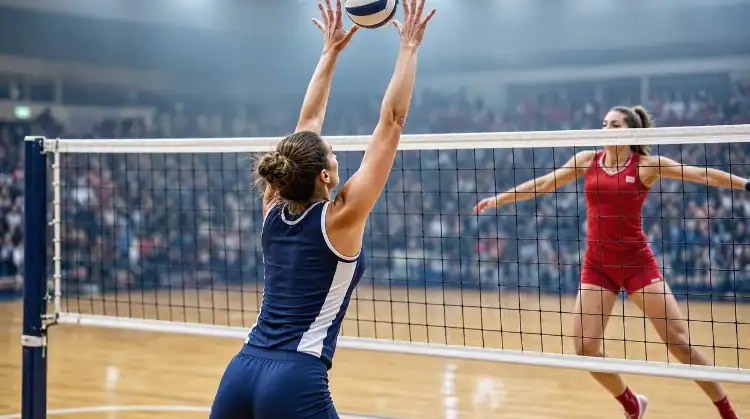
This is the biggest strategic choice at the net. With a read block, you hold your position for a split second, watch where the setter sends the ball, then move and jump to meet the hitter. It is the safe, reliable option and what most players use.
A commit block is the aggressive one. You decide to jump with a specific hitter, usually the quick-attacking middle, before the set even leaves the setter’s hands. Time it right and you shut down a fast offense. Time it wrong and you are already coming down as the real attack goes up.
Swing Block
The swing block is the modern standard at higher levels, and most guides skip it. Instead of shuffling sideways with your hands held up the whole way, you swing your arms and run along the net like a hitter’s approach.
That extra momentum gets you higher and further across the net, so you can close on outside attacks you would never reach with a shuffle.
Soft Block
Sometimes you are not going to stuff a big hitter, and trying to will just get you tooled. A soft block is the smart answer. You angle your hands back and slightly up so the hard-driven ball deflects high off your hands instead of flying out of bounds.
Your back-row defense then has an easy ball to chase down and keep the rally alive. It is a great tool for shorter blockers.
Split Block
A split block is the one you plan ahead of time. Instead of forming a tight wall, two blockers deliberately split apart so one takes the line and the other takes the sharp angle. It is a surprise tactic, best saved for a hitter who keeps slicing shots around a normal block.
Line vs Cross-Court Block
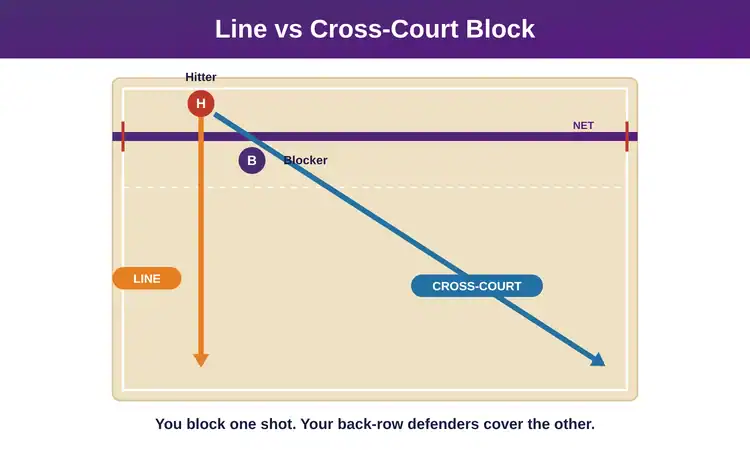
This one is about which attack you take away. “Blocking line” means you set your hands to wall off the hitter’s shot straight down the sideline.
“Blocking cross-court” means you cover the sharp diagonal. You cannot cover everything, so the rule is simple: you block one shot, and your back-row defenders cover whatever you leave open.
How to Block in Volleyball: Step-by-Step Technique
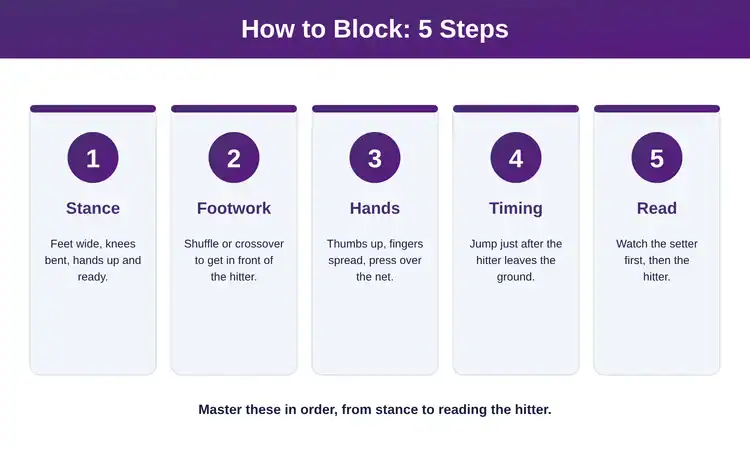
Good blocking is a skill you can learn, not just a gift for tall players. It comes down to five things done in the right order: stance, footwork, hands, timing, and reading the hitter. Nail these and you will stuff balls you used to watch sail past.
1. Start in a Strong Ready Position
Stand about an arm’s length from the net so you have room to jump straight up without touching it. Keep your feet a little wider than your shoulders, knees slightly bent, and your hands up near your chest or shoulders. You want to be loaded like a spring, ready to move either way the second the setter touches the ball.
2. Move With the Right Footwork
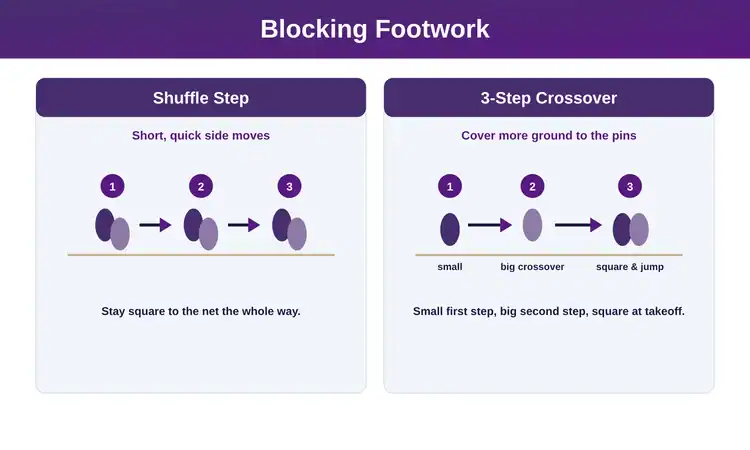
Your feet get you in front of the hitter, so this is where most blocks are won or lost. For a short move, use a quick shuffle step and keep your shoulders square to the net. For a longer move out to the pins, use a crossover step, also called the 3-step crossover, or the swing-block approach to cover more ground fast.
The goal is simple: arrive, plant, and be balanced before you jump, never still drifting sideways in the air.
3. Set Your Hands the Right Way
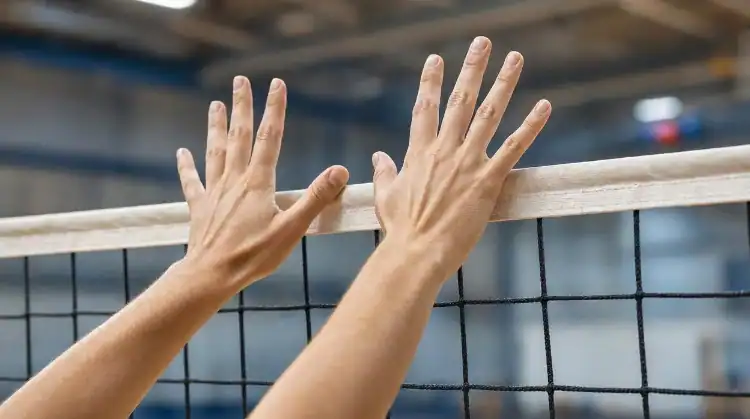
Press your hands up and over the net with your fingers spread wide and firm. Point your thumbs up toward the ceiling so your hands angle slightly inward over the net, which keeps the ball on the opponent’s side instead of letting it slip through.
Reach forward and over, not just straight up. This is called penetration, and it is what turns a touch into a stuff. Keep your hands close enough that the ball cannot squeeze between them.
4. Time Your Jump
Timing separates good blockers from great ones. As a rule, you jump just after the hitter does, not with them. The hitter leaves the ground first, floats up, then swings, so if you wait a beat you will meet the ball at its highest point with your hands already in position.
Jumping too early means you are coming down as they hit. Jumping too late means the ball is already past your hands.
5. Read the Hitter
The best blockers seem to know where the ball is going before it is hit, and that is pure reading. Watch the setter first to see where the ball goes, then lock onto the hitter’s approach angle, shoulders, and arm swing.
A hitter whose shoulder turns toward the sideline is likely going down the line. One who stays square is more likely to go cross-court. The more you watch film and play, the faster this becomes automatic.
One more thing worth knowing: you are allowed to reach over the net to block, but you cannot touch the net itself while you play the ball. If your momentum keeps carrying you into it, that is a fault. We cover the details in our guide on whether you can touch the net in volleyball.
Blocking by Position: Who Blocks and Their Job
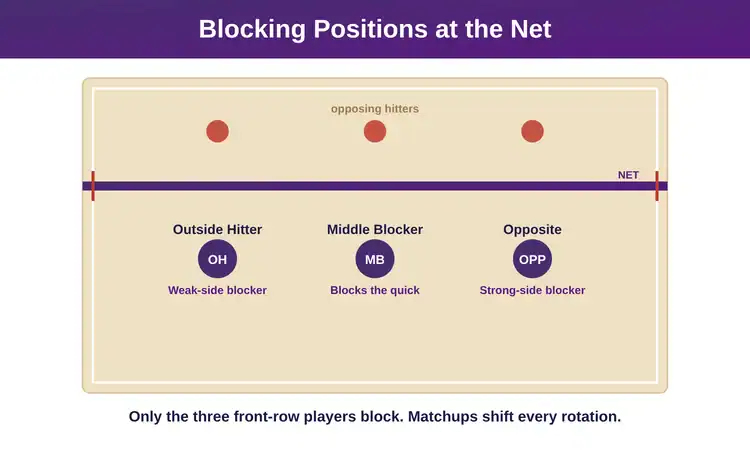
Only the three front-row players block, but they do not all do the same job. Where you start and what you are responsible for depends on your position on the court.
Middle Blocker
The middle blocker is your blocking specialist and usually the tallest player on the team.
They start in the middle of the net and have the hardest job: reading the quick middle attack while also sprinting out to help form a double block on the outside hitters. The middle is almost always the primary blocker, the one who gets in front of the attacker first.
Outside and Opposite (Pin Blockers)
The outside hitter and the opposite are called pin blockers because they start near the antennas, or “pins,” at each end of the net.
You will also hear them called the weak side blocker on the left and the strong side blocker on the right. The strong side blocker usually lines up against the other team’s best outside hitter, so it is a big defensive responsibility.
Closing the Block
When two players block together, one is the primary blocker in front of the hitter, and the second has to close the block, sliding in tight to seal the gap between their hands. If that gap stays open, good hitters will drive the ball straight through it. The two blockers also need to jump in unison, not one after the other, so the wall goes up as one solid surface.
How Blocking Fits Your Rotation
Here is the part beginners miss: who blocks where changes every rally as the team rotates.
As players rotate through the six spots, different people cycle into the front row, so your blocking matchups shift constantly.
Understanding how volleyball rotations work is what lets you know who you are blocking before the serve even goes up.
And no, you do not have to be a giant to block well. Height helps with reach, but timing and reading beat raw inches more often than people think. We break this down in our guide on whether you need to be tall to play volleyball.
Indoor vs Beach Volleyball Blocking
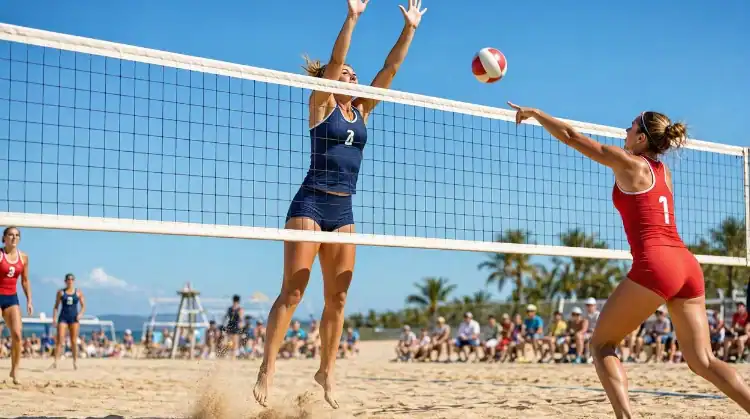
Blocking looks similar on sand, but a few rules and tactics change completely. If you are moving between indoor and beach, these differences matter. The net is the same height in both, but almost everything around it changes.
| Factor | Indoor | Beach |
|---|---|---|
| Players who can block | Up to 3 front-row players. | Usually just 1 of the 2 players. |
| Does the block count as a contact? | No. | Yes, it counts as the first of three. |
| Hand signals | Mostly called out loud. | Given behind the back before every serve. |
| Choosing not to block | Less common. | Common, the blocker pulls off the net to defend. |
| Conditions | Controlled indoor court. | Wind and sun are always in play. |
The biggest rule difference is contacts. Indoors, your block does not count as a hit, so you keep all three contacts afterward.
On the beach, the block counts as your team’s first contact, so you only have two touches left to dig and send it back. That one rule changes how beach teams think about going up at the net at all.
The second big difference is communication. With only two players, beach blockers flash hand signals behind their back before the serve, telling their partner whether they will take the line or the angle.
That way the defender knows exactly which part of the court to cover. Sometimes the signal is “no block” at all, and the blocker drops off the net to play defense instead.
Common Blocking Mistakes (and How to Fix Them)
Most blocking problems are not about talent. They are small habits that quietly cost your team points. Here are the most common ones and the fix for each.
- Standing too far from the net. When you jump from too far back, you cannot reach over to penetrate, and hitters will tool the ball off your hands. Fix it by starting about an arm’s length from the net and pressing your hands forward over it.
- Mistiming the jump. Jumping with the hitter instead of just after them is the number one timing error. Fix it by watching the hitter leave the ground first, then going up a beat later so you meet the ball at its peak.
- Pulling your hands back before you jump. This double movement wastes time and lets the ball through. Fix it by driving your hands straight up and over in one clean motion, never cocking them backward first.
- Over-committing to one hitter. Locking onto a single attacker leaves you flat-footed against quick sets and back-row attacks. Fix it by reading the setter first, then reacting, rather than guessing early.
- Drifting into the net. Floating sideways in the air often ends with your body brushing the net, which is a fault. Fix it by jumping straight up and landing in the same spot, with your balance set before you leave the ground.
- Getting caught by the tip. Blockers set for a hard spike often get beaten by a soft tip or dink dropped just over their hands. Fix it by watching the hitter’s arm all the way through; a slow arm swing usually means a tip is coming.
Work through these one at a time in practice. Fixing even the first two, your spacing and your timing, will stop more attacks than any amount of extra height ever could.
Volleyball Blocking Drills to Improve
You get better at blocking by doing it, not by watching it. These three drills build the core skills in order: footwork first, then hands, then reading. Add them to your practice and the technique above starts to feel automatic.
1. Mirror Footwork Drill
Stand at the net facing a partner or coach on the other side. As they shuffle or crossover left and right along the net, you mirror their movement step for step, keeping your hands up and shoulders square the whole time. No ball, no jumping at first. This trains clean, balanced footwork so you stop drifting sideways in the air.
2. Block Over the Box
Have a hitter stand on a box or raised platform right at the net and hit controlled balls down at you. Your only job is to set your hands correctly, penetrate over the net, and press the ball down. Because the hitter is stationary, you can repeat good hand position over and over until it sticks. This is the fastest way to fix a weak or soft block.
3. Read and React
Now put it together. A setter runs a live set to one of two or three hitters, and you do not know in advance who is getting the ball. You read the setter, move to the right hitter, and block. This is the closest drill to a real game and sharpens the decision-making that separates good blockers from great ones.
Want a full practice plan? We have a whole set of advanced volleyball drills to round out the rest of your training.
Frequently Asked Questions
Can the libero block in volleyball?
No. The libero is never allowed to block or even attempt to block, indoors or on the beach. It is one of the clear restrictions that comes with the position’s special defensive role.
Can you spike or attack the ball off a block?
Yes. Because a block does not count as one of your three contacts, a player can go right back up and attack a ball that rebounds off the block. The same player is even allowed to make that next contact.
What is a block assist in volleyball?
A block assist is a stat credited to each player who takes part in a block together. If two or three blockers go up and the ball deflects off the block, every player involved gets a block assist, sometimes called a collective block. It rewards the teamwork of closing a wall, not just the one player who touched the ball.
What is the hardest position to block?
Middle blocker is widely considered the toughest. They have to read the quick attack in the center while also sprinting out to help block on the pins, all in a fraction of a second.
Can you block a set or an overpass?
Yes. If a set or a bad pass drifts over to your side of the net, you are allowed to block or attack it. The one ball you can never block is the serve.
Why can’t you block a serve in volleyball?
Because the rules require the serve to be played as a normal first contact. Blocking or attacking the serve at the net is illegal and hands the serving team an instant point.
Final Thoughts
Blocking is one of the most satisfying skills in volleyball, and it rewards smart players as much as tall ones. Get the fundamentals right, your spacing, your timing, and your hands over the net, and you will turn away attacks that used to feel impossible to stop.
Start with the footwork and the reading, since those win more blocks than raw height ever will. Learn the rules so you are not giving away easy points. Then put in the reps with the drills above until it all clicks. Do that, and you go from standing at the net hoping, to owning it.
Now get out there and put up a roof.
